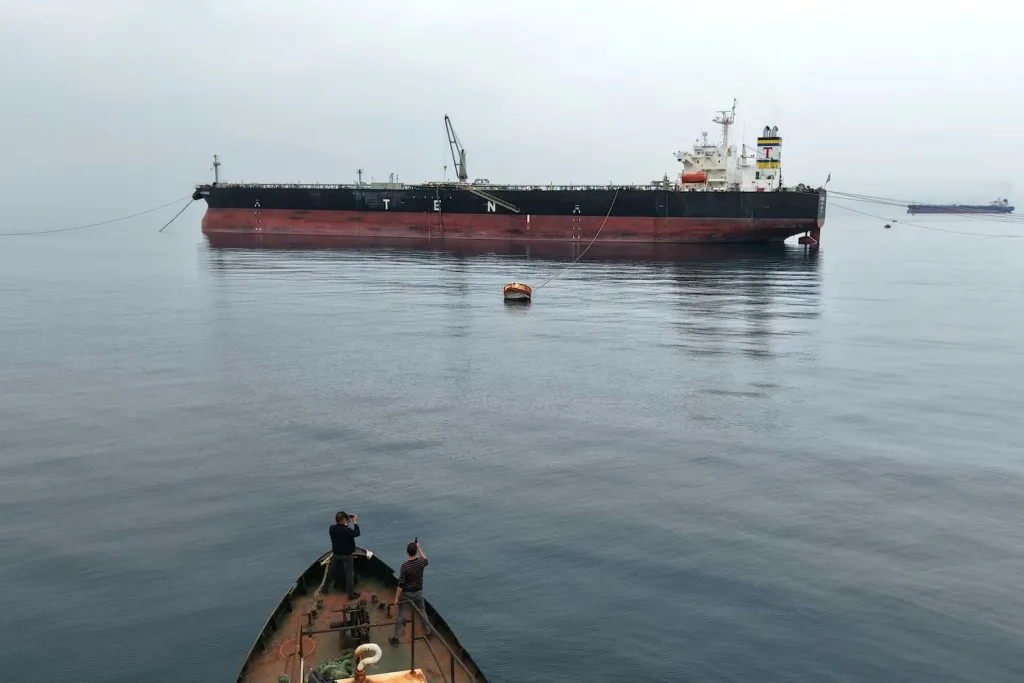
Why Iran Isn’t Blinking Yet
The U.S. has imposed a semi-porous blockade on Iranian shipping in an effort to force Iran to shut down oil production due to lack of storage, hoping to inflict severe economic damage. Iran, however, has faced similar sanctions before and has not suffered lasting harm to its oil infrastructure, allowing it to resist U.S. pressure. Despite reduced exports, Iran continues to export some oil and is using floating and onshore storage to delay production cuts, while global oil prices rise.
- ▪The U.S. blockade aims to force Iran to shut down oil wells by limiting its ability to store crude oil.
- ▪Iran has used old tankers and onshore facilities to store oil and has continued some exports despite the blockade.
- ▪Previous U.S. sanctions under both Obama and Trump led to production shutdowns but did not cause lasting damage to Iran’s oil fields.
- ▪U.S. allies in the Gulf are also experiencing large-scale production shutdowns, reducing the relative impact on Iran.
- ▪Global oil prices have risen above $111 per barrel, partially offsetting revenue losses for Iran and reducing pressure to concede.
Foreign Policy files mainly under world. We currently carry 82 of its stories.
Story provenance
Source · retrieval · rights · ranking — open for full record
inspect →
Story provenance
Attribution is not the same as permission. This drawer separates discovery metadata, excerpts, WeSearch-generated summaries, reuse status, and whether the publisher receives the visit. Nothing here claims a legal grant the publisher has not made.
Record
| Original publisher | Foreign Policy |
| Canonical URL | https://foreignpolicy.com/2026/04/28/iran-war-hormuz-trump-oil-storage-blockade-energy/ |
| Publication time | Tue, 28 Apr 2026 17:40:22 +0000 |
| Retrieval time | 2026-04-28T17:59:40.768Z |
| Last seen | 2026-04-28T17:59:40.768Z |
| Headline source | Publisher (no WeSearch rewrite) |
| Excerpt source | publisher body |
| Excerpt method | First ~120 words (~800 chars) of extracted publisher body, fair-use limited. |
| Summary | WeSearch · cerebras-chat (WeSearch summarizer) |
| Summary source text | contentText |
| Citation coverage | Summary is a WeSearch-generated derivative; primary citation is the original publisher URL. |
| Cluster | egl79c0PILIT |
| Cluster logic | Grouped by semantic title/content similarity across sources within a rolling window. Same-publisher template collisions are excluded from coverage comparison. |
| Ranking reason | Story pages are not engagement-ranked. Hub feeds use recency, with optional source-diversified chronological ordering (cap consecutive stories per source). No personalized ranking. |
| Publisher visit | Yes — open original |
| Substitutes article? | No — link-out required for full text |
Rights status (four layers)
WeSearch handling by dimension
| Indexing | May the item be indexed (stored, ranked, made findable)? | Allowed |
| Snippet | May a short excerpt of the publisher's text be shown? | Allowed |
| AI summary | May WeSearch generate its own short summary of the article? | Limited |
| Retrieval / RAG | May the content be exposed for third-party retrieval-augmented generation? | Not asserted |
| Model training | May the content be used to train AI models? | Not asserted |
| Commercial reuse | May the content be reused commercially? | Not permitted |
Basis: Derived from the published RSS/Atom feed. Contact: [email protected]. Reviewed: 2026-07-24.
Opening excerpt (first ~120 words) tap to expand
Analysis Why Iran Isn’t Blinking Yet Trump’s blockade aims to force damaging shutdowns at Iranian oil fields. But Tehran has been through this before. By Keith Johnson, a staff writer at Foreign Policy covering geoeconomics and energy. A Greek-flagged crude oil tanker seen off the coast of the Syrian Baniyas port refinery, along the Mediterranean Sea. A Greek-flagged crude oil tanker seen off the coast of the Syrian Baniyas port refinery, along the Mediterranean Sea on April 15. Bakr ALkasem / AFP Get audio access with any FP subscription. Subscribe Now ALREADY AN FP SUBSCRIBER? LOGIN April 28, 2026, 1:40 PM Iran War Analysis and news. In a way, the impasse between the United States and Iran over the still-closed Strait of Hormuz boils down to storage.
…
Excerpt limited to ~120 words for fair-use compliance. The full article is at Foreign Policy.
Discussion
0 commentsMore from Foreign Policy