
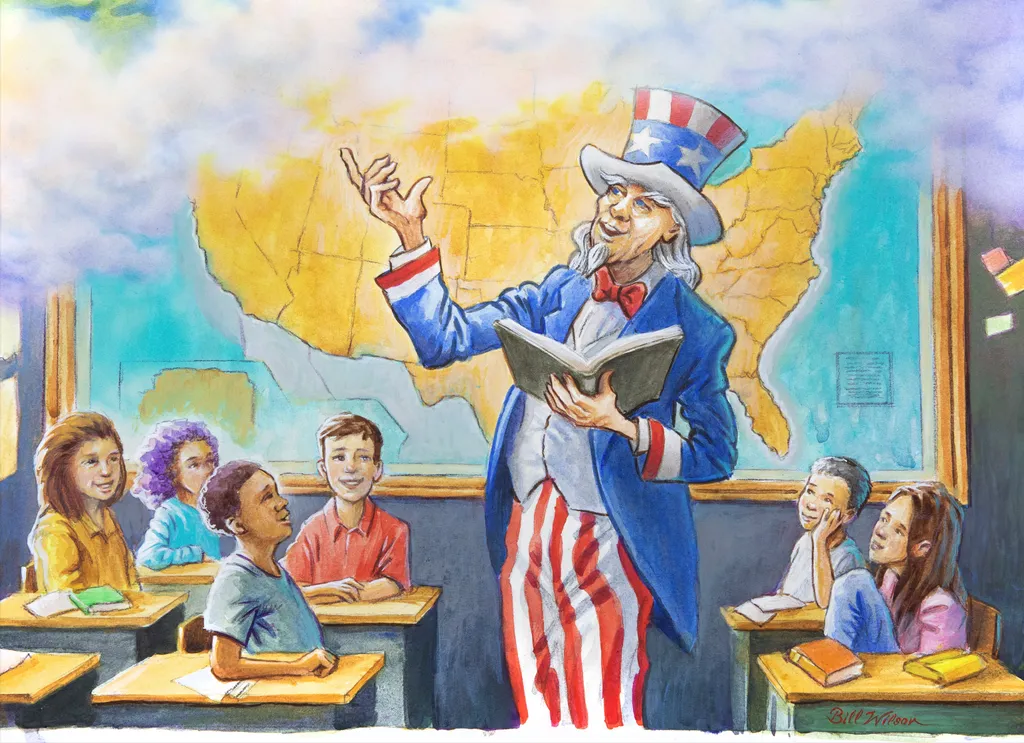
Why Young People Need a Patriotic Education
The article discusses the need for a patriotic education in America, arguing that current educational narratives often portray the country negatively. It emphasizes the importance of teaching young people about America's founding principles and historical achievements while acknowledging its imperfections. The author believes that a well-rounded education can inspire a renewed sense of national pride and purpose among students.
- ▪Many young people are taught to view America as a source of injustice rather than a force for good.
- ▪A patriotic education should include a serious study of America's founding principles and historical achievements.
- ▪The author argues that understanding both the successes and failures of the nation can foster a renewed sense of pride and purpose among students.
The American Spectator files mainly under politics. We currently carry 159 of its stories.
Story provenance
Source · retrieval · rights · ranking — open for full record
inspect →
Story provenance
Attribution is not the same as permission. This drawer separates discovery metadata, excerpts, WeSearch-generated summaries, reuse status, and whether the publisher receives the visit. Nothing here claims a legal grant the publisher has not made.
Record
| Original publisher | The American Spectator | USA News and Politics |
| Canonical URL | https://spectator.org/why-young-people-need-a-patriotic-education/ |
| Publication time | Thu, 04 Jun 2026 02:04:51 +0000 |
| Retrieval time | 2026-06-04T02:06:07.365Z |
| Last seen | 2026-06-04T02:06:07.365Z |
| Headline source | Publisher (no WeSearch rewrite) |
| Excerpt source | publisher body |
| Excerpt method | First ~120 words (~800 chars) of extracted publisher body, fair-use limited. |
| Summary | WeSearch · cerebras-chat (WeSearch summarizer) |
| Summary source text | contentText |
| Citation coverage | Summary is a WeSearch-generated derivative; primary citation is the original publisher URL. |
| Cluster | 5E8B3qwEh3Uy |
| Cluster logic | Grouped by semantic title/content similarity across sources within a rolling window. Same-publisher template collisions are excluded from coverage comparison. |
| Ranking reason | Story pages are not engagement-ranked. Hub feeds use recency, with optional source-diversified chronological ordering (cap consecutive stories per source). No personalized ranking. |
| Publisher visit | Yes — open original |
| Substitutes article? | No — link-out required for full text |
Rights status (four layers)
WeSearch handling by dimension
| Indexing | May the item be indexed (stored, ranked, made findable)? | Allowed |
| Snippet | May a short excerpt of the publisher's text be shown? | Allowed |
| AI summary | May WeSearch generate its own short summary of the article? | Limited |
| Retrieval / RAG | May the content be exposed for third-party retrieval-augmented generation? | Not asserted |
| Model training | May the content be used to train AI models? | Not asserted |
| Commercial reuse | May the content be reused commercially? | Not permitted |
Basis: Derived from the published RSS/Atom feed. Contact: [email protected]. Reviewed: 2026-07-24.
Opening excerpt (first ~120 words) tap to expand
In classrooms across America today, too many young people are being taught to view their country not as a force for good, but as a source of injustice. The heroes of history are recast as villains. National pride is replaced by shame. The result is not a generation prepared to lead a free people, but one too often uncertain whether America is a nation worth defending at all.This article is from The American Spectator’s summer 2026 print magazine. Subscribe to The American Spectator to receive the magazine.That uncertainty would have deeply troubled George Washington.
…
Excerpt limited to ~120 words for fair-use compliance. The full article is at The American Spectator | USA News and Politics.
Discussion
0 comments