Search results for “earl” in Science
Search publisher headline and short source-description metadata, not paywalled article text.
Indexed headlines
25–48 of 74 resultsWill there be a White Christmas this year?
It is just a month until the big day but what do the early signs say about the chances of a white Christmas in the UK?
Innovative technology offers a bold new vision for monitoring ocean health
On an early October morning, as MBARI's research vessel Paragon left Moss Landing with three robots loaded on its deck, Monterey Bay was showing off.
Seeds, preserved hair in tomb point to oldest signs of cannabis high 2,800 years ago, study suggests
People may have been getting high off cannabis earlier than previously thought—at least 2,800 years ago, a new study suggests.
An atom-sized black hole could force an entire star to explode
The early universe may have produced minuscule black holes, and if they are still around today they could devour stars from the inside or blow them up entirely
Huge extinct orca may have eaten other whales
A nearly 8-metre-long species of orca lived in the North Sea over 2 million years ago. Its discovery suggests orcas evolved a diet of marine mammals earlier than scientists thought
These Killer Female Apes Challenge the ‘Man the Hunter’ Origin Story
Bonobos are as closely related to humans as chimps. New evidence that female bonobos are the primary hunters could radically alter our understanding of early human societies.
Bloody, brutal and growing: More states are adopting the firing squad as an execution method
In early December, Americans will consider whether they can stomach an execution by firing squad and whether the US should be carrying out executions at all.
Queensland keeps learning disaster lessons. So why do we keep forgetting them?
After an early start to Queensland's storm season, with severe storms and flooding already affecting communities across the state, attention is once again turning to disaster preparedness and response.
Toddlers form complex memories but may then lose access to them
Few of us can remember events from our earliest years, but that might be because we lose the ability to recall memories - not because we didn't make them in the first place
What are AI chips, and what’s so special about Nvidia’s?
Nvidia found itself in the right place at the right time. It was the dominant seller of graphics chips by the early 2000s, and those chips later turned out to be well suited for running AI.
Mysterious new viruses reveal a missing link in evolution
Scientists have discovered previously unknown viruses that could help explain how some of life’s earliest biological structures evolved. The surprising findings challenge a longstanding evolutionary theory and suggest that viruses may have hidden capabilities far b
Eagles preying on human-sized baboons upend existing evolutionary defense theory
Researchers from the University of St Andrews have discovered that baboons the size of hominins (early human ancestors) are being preyed upon by eagles, reshaping the way scientists might think about predator–prey interactions during human evolution.
Giant deer bones may push human arrival in Ireland back by 1,000 years
A team of archaeologists and scientists has uncovered tantalizing new evidence that Late Upper Paleolithic hunter-gatherers may have lived in southern Ireland around 13,500 years ago—nearly a millennium earlier than currently confirmed.
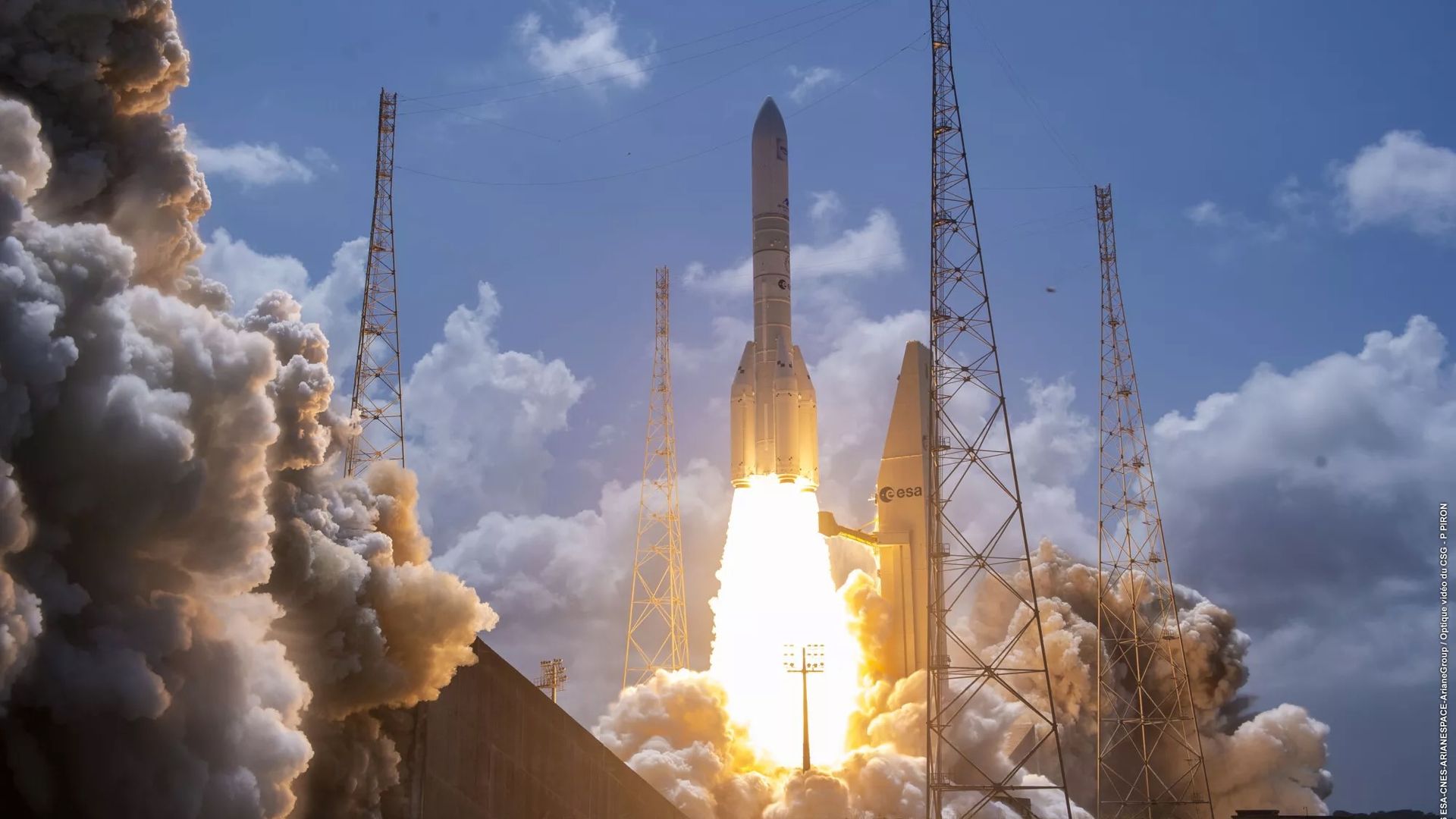
Watch live on Nov. 23: Amazon launching 1st batch of internet satellites since Vulcan Centaur failure
An Ariane 6 rocket will launch 36 Amazon broadband satellites to orbit early on Nov. 23, just eight days after a ULA Vulcan Centaur failed during its mission for Amazon. Watch it live here.
Webb discovers farthest 'little red dot' from universe's first 500 million years
Following the discovery of faint supermassive black holes called little red dots (LRDs) in the early universe in 2022, an international team of researchers has found the farthest little red dot to date, reports a new study in The Astrophysical Journal Letters.
Hostility in online heat wave discussions shows signs of contagion, study suggests
Anger and frustration can run high in online discussions about climate change. But a new study led by Nanyang Technological University, Singapore (NTU Singapore) suggests that hostility in these conversations tends to follow earlier hostility, hinting that people m
Babies in ancient Greek colony started solid food at 3 months but nursed for nearly 4 years, chemical signatures suggest
Over 2,500 years ago, Himera was a Greek colony inhabited by local Sicilians, Phoenicians and Greeks. Despite their diverse cultural backgrounds, they all shared one thing: they began weaning their babies early and continued for a long time.
Earth’s tectonic engine may have switched on 2.5 billion years ago
A mysterious chemical fingerprint hidden in ancient rocks has revealed a fundamental transformation in Earth’s geological history about 2.5 billion years ago. Scientists discovered that traces of the planet’s earliest crust abruptly disappeared from the geological
How old is that puggle? Scientists develop first X-ray aging guide for echidnas
A collaboration between Murdoch University researchers and veterinarians at Taronga Zoo has produced the first detailed radiographic aging guide for short-beaked echidnas, providing a practical new way to estimate the age of these iconic Australian mammals from the
Stanford scientists discover hidden brain signals that predict Alzheimer’s years before symptoms
Stanford researchers have discovered that hidden patterns of brain activity can predict Alzheimer’s risk years before memory problems appear, potentially offering an earlier warning than traditional biomarkers. The same patterns also reveal which brains are unusual
Fine particle pollution may weaken spring greening by clogging leaf pores
Each spring, warmer temperatures can bring earlier leaf-out, while rising atmospheric carbon dioxide can stimulate plant growth, allowing land ecosystems to absorb more carbon. Yet a study published in Nature Plants on Nov. 27 finds that this climate-driven greenin
Do all groups drift toward rule by the few? Not when time is on their side
For more than a century, a bleak idea has hung over the ideal of democracy: Given enough time, every group ends up ruled by a few. The idea, known as the iron law of oligarchy, was first proposed by the sociologist Robert Michels in the early 1900s.
Hidden for 100 million years: X-rays reveal an ancient flower from the age of dinosaurs
In a new paper published in the American Journal of Botany, a team of scientists from the U.S. and UK reveal an incredible fossil from the mid-Cretaceous period (around 100 million years ago), opening up a new window into the early evolutionary history of modern-da
125,000 years ago, hippos roamed what is now the vast Arabian Desert
A remarkable 125,000-year-old discovery in Saudi Arabia reveals that early humans once thrived beside enormous lakes filled with wildlife in what is now a vast desert. Thousands of stone tools and ancient plant remains suggest these prehistoric people used sophisti