Search results for “early” in Science
Search publisher headline and short source-description metadata, not paywalled article text.
Indexed headlines
25–48 of 53 resultsAn atom-sized black hole could force an entire star to explode
The early universe may have produced minuscule black holes, and if they are still around today they could devour stars from the inside or blow them up entirely
These Killer Female Apes Challenge the ‘Man the Hunter’ Origin Story
Bonobos are as closely related to humans as chimps. New evidence that female bonobos are the primary hunters could radically alter our understanding of early human societies.
Bloody, brutal and growing: More states are adopting the firing squad as an execution method
In early December, Americans will consider whether they can stomach an execution by firing squad and whether the US should be carrying out executions at all.
Queensland keeps learning disaster lessons. So why do we keep forgetting them?
After an early start to Queensland's storm season, with severe storms and flooding already affecting communities across the state, attention is once again turning to disaster preparedness and response.
What are AI chips, and what’s so special about Nvidia’s?
Nvidia found itself in the right place at the right time. It was the dominant seller of graphics chips by the early 2000s, and those chips later turned out to be well suited for running AI.
Eagles preying on human-sized baboons upend existing evolutionary defense theory
Researchers from the University of St Andrews have discovered that baboons the size of hominins (early human ancestors) are being preyed upon by eagles, reshaping the way scientists might think about predator–prey interactions during human evolution.
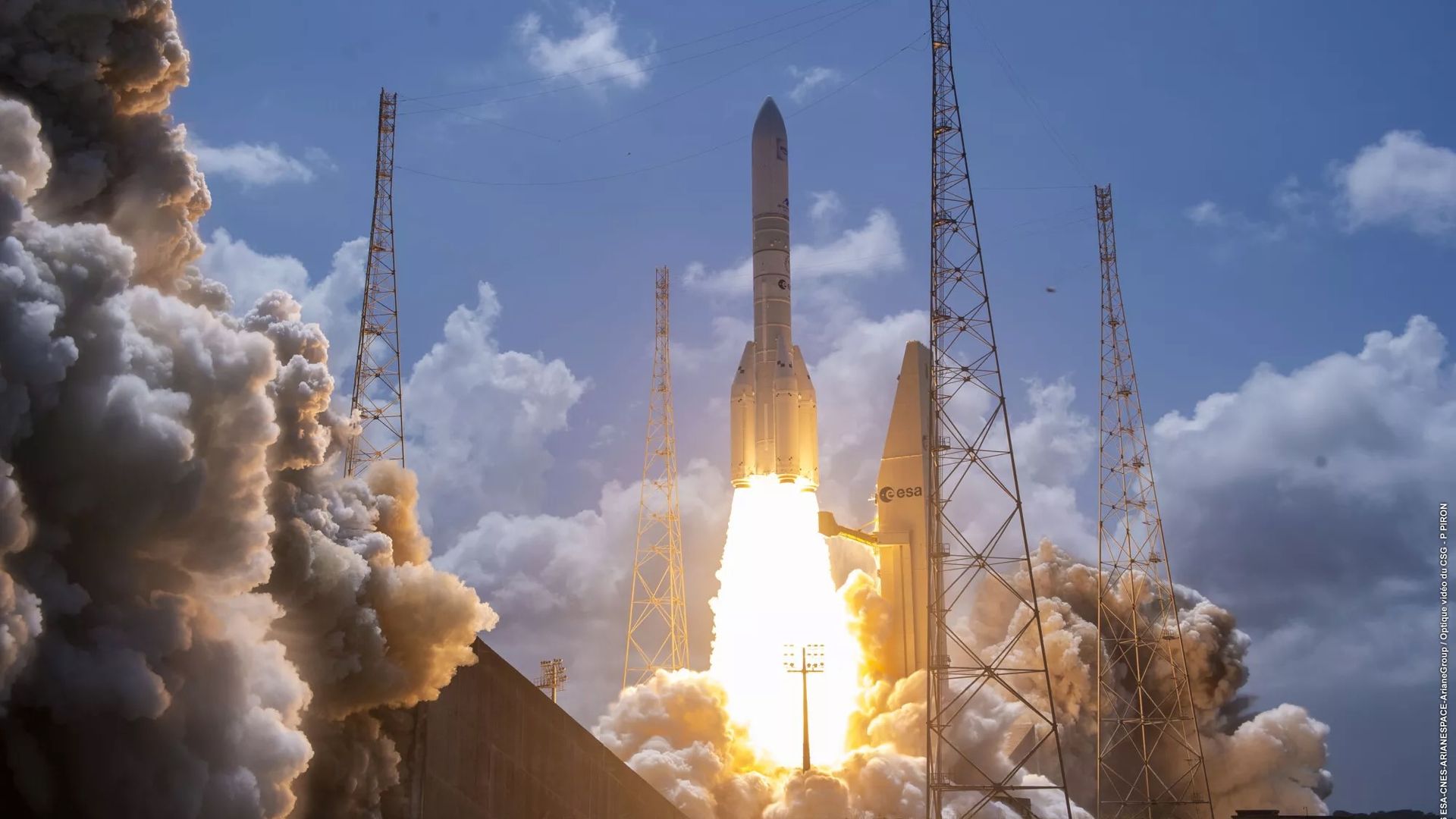
Watch live on Nov. 23: Amazon launching 1st batch of internet satellites since Vulcan Centaur failure
An Ariane 6 rocket will launch 36 Amazon broadband satellites to orbit early on Nov. 23, just eight days after a ULA Vulcan Centaur failed during its mission for Amazon. Watch it live here.
Webb discovers farthest 'little red dot' from universe's first 500 million years
Following the discovery of faint supermassive black holes called little red dots (LRDs) in the early universe in 2022, an international team of researchers has found the farthest little red dot to date, reports a new study in The Astrophysical Journal Letters.
Babies in ancient Greek colony started solid food at 3 months but nursed for nearly 4 years, chemical signatures suggest
Over 2,500 years ago, Himera was a Greek colony inhabited by local Sicilians, Phoenicians and Greeks. Despite their diverse cultural backgrounds, they all shared one thing: they began weaning their babies early and continued for a long time.
How old is that puggle? Scientists develop first X-ray aging guide for echidnas
A collaboration between Murdoch University researchers and veterinarians at Taronga Zoo has produced the first detailed radiographic aging guide for short-beaked echidnas, providing a practical new way to estimate the age of these iconic Australian mammals from the
Do all groups drift toward rule by the few? Not when time is on their side
For more than a century, a bleak idea has hung over the ideal of democracy: Given enough time, every group ends up ruled by a few. The idea, known as the iron law of oligarchy, was first proposed by the sociologist Robert Michels in the early 1900s.
Hidden for 100 million years: X-rays reveal an ancient flower from the age of dinosaurs
In a new paper published in the American Journal of Botany, a team of scientists from the U.S. and UK reveal an incredible fossil from the mid-Cretaceous period (around 100 million years ago), opening up a new window into the early evolutionary history of modern-da
125,000 years ago, hippos roamed what is now the vast Arabian Desert
A remarkable 125,000-year-old discovery in Saudi Arabia reveals that early humans once thrived beside enormous lakes filled with wildlife in what is now a vast desert. Thousands of stone tools and ancient plant remains suggest these prehistoric people used sophisti
Digital imaging workshop aims to reveal secrets in medieval manuscripts
Researchers recently used multispectral imaging technology to try to uncover hidden information from medieval manuscripts at the Rare Book and Manuscript Library at the University of Illinois Urbana-Champaign. The library hosted a digital imaging workshop in early
This 345-million-year-old fossil had scientists fooled for decades
A famous 345-million-year-old fossil has turned out to be something entirely different from what scientists believed for decades. Advanced X-ray imaging revealed hidden gills and thousands of tiny teeth, exposing a primitive aquatic or amphibious creature rather th
Ancient rocks from the Moon’s far side rewrite the Solar System’s violent past
Scientists studying ancient rocks from the Moon’s far side have uncovered surprising evidence that challenges decades of thinking about the Solar System’s violent past. Instead of a single catastrophic bombardment, asteroid impacts appear to have declined gradually
How mammals zigzagged their way to modern posture
This is the story of how mammals came to dominate the Earth—and the crooked evolutionary path they trod en route. Early mammals and their ancestors left behind fossilized bones, footprints and lots of questions about how they moved. One key element of their evoluti
Beneficial fungus could offer a new way to control strawberry powdery mildew
Strawberry powdery mildew (PM), caused by the fungus Podosphaera fragariae, is a serious disease that can affect leaves, flowers, fruit and other aerial parts of strawberry plants. Infection can reduce both crop yields and fruit quality. The disease often first app
New fern species discovered after nearly 200 years of being mistaken for another
Chinese researchers have formally described a new fern species that has been hiding in plain sight for nearly 200 years. Named Drynaria lineatisora, the species was collected as early as the 19th century in Myanmar and Vietnam, but it was repeatedly misidentified a
Alzheimer’s may start shrinking two brain regions years before memory loss
Johns Hopkins scientists have uncovered hidden warning signs of Alzheimer’s disease that may appear up to a decade before memory loss begins. Brain scans revealed that two regions involved in memory and emotion start shrinking before the hippocampus, the area docto
Individual meerkats are ace solo navigators
After meerkats emerge each morning from their burrow to warm in the early sun, there's one thing on their collective mind, and that's to find food. They navigate communally as they head off, working slowly along their route before returning home swiftly at the end
Why mega-constellations have a hidden space junk blind spot
We are consistently launching more and more stuff into space. As of now, space agencies track more than 30,000 objects larger than a softball, with an expected 1 million more bullet-sized pieces of debris orbiting Earth that are too small to spot from the ground. G
Super El Niño will add to Africa's heat crisis—how governments can protect people before it peaks
The super El Niño developing in the Pacific is expected to strengthen toward the end of 2026 and persist into early 2027. It's set to intensify dangerous heat and cause severe drought across parts of Africa. This is likely to mean more heat-related illness and deat
El Niño created a skiers' paradise in Chile—now it's Sierra Nevada and southern Rockies' turn
El Niño has a reputation for being a skier's dream, bringing lots of snow to California's Sierra Nevada and the southern Rockies. Tahoe-area resorts were already seeing the effects in mid-November 2026 as several feet of snow fell and some resorts prepared to open