AI euphoria getting reality check in South Korea, and vice versa
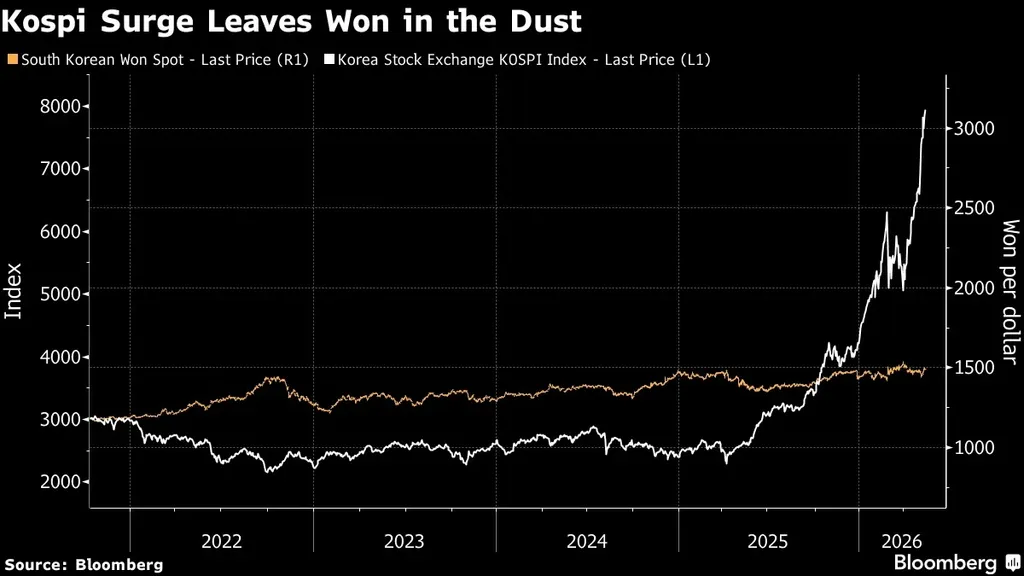
South Korea's economy is experiencing a stark contrast between the plummeting won and the soaring Kospi index. While the Kospi has surged significantly due to AI-driven market enthusiasm, the won has weakened, raising concerns among economists. Analysts suggest that creative policy measures are needed to stabilize the currency amidst fears of overvaluation in the stock market.
- ▪The South Korean won has dropped 4.5% this year, making it one of Asia's weakest currencies.
- ▪The Kospi index has increased by 85% since the beginning of the year, driven by AI-related investments.
- ▪Economists are calling for innovative policies to strengthen the won, as foreign investors have been selling domestic assets.
- ▪Despite the stock market's success, concerns about the sustainability of this growth and the 'Korea discount' remain.
- ▪The surging US dollar and rising energy costs pose additional challenges to South Korea's economy.
Asia Times files mainly under world. We currently carry 141 of its stories.
Opening excerpt (first ~120 words) tap to expand
TOKYO — Few market visuals are more striking than the South Korean won and the Kospi index suddenly tearing off in opposite directions. The won has slumped 4.5% this year, putting it among Asia’s weakest currencies. The Kospi, meanwhile, has exploded — up 85% since Jan. 1 and 200% over the past year. The frenzy propelling Seoul stocks to record after record is rooted in artificial‑intelligence mania. Tech giants SK Hynix, up 873% in twelve months, and Samsung Electronics, up 447%, are doing most of the heavy lifting. The stock surge has given President Lee Jae‑Myung an almost sorcerous market aura. On the campaign trail before taking office in June 2025, he vowed to lift the Kospi to 5,000 – a target that implied doubling the index over his five‑year term.
…
Excerpt limited to ~120 words for fair-use compliance. The full article is at Asia Times.
Discussion
0 commentsMore from Asia Times