
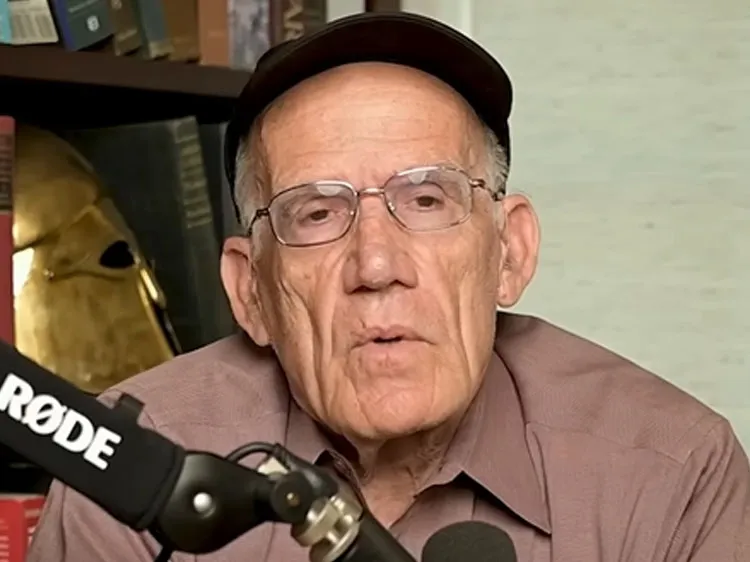
'Apostate Right' and the Left Are Dead Wrong on Iran
Victor Davis Hanson argues that the key difference between Trump’s Iran dealand the Obama-era deal is that Iran is now far weaker militarily and economically. He pushes back on criticism from the left and the anti-interventionist right, saying the war may help Trump politically if the Strait of Hormuz reopens and oil prices fall before the midterms. VICTOR DAVIS HANSON: There’s a lot of confusion, controversy, and disagreement about the latest phase of the Iran war. Remember, we bombed kinetically 38 to 40 days, then we had 60 days of negotiation, then here we are in mid-June, in which [President] Donald Trump has announced yet another time there is going to be a peace deal coming with a 60-day period for all the elements of the deal to be enacted. A lot of people are upset. They feel that Iran was on the ropes, they’re going broke, and that had we continued, or if we were to continue now, we could put them out of commission and then dictate an un-conditional surrender to them. That’s absolutely true, but what this deal then hinges on—because there’s no history of Iran ever keeping their word or following any agreement, explicit or implicit—is the willingness to keep maybe one carrier group in the region to ensure that the strait stays open, that the missiles are not launched against our allies, and of course, the enriched uranium is turned over. And if we’re willing to do that and hit them hard every time they break it, then it might eventually work. There are a lot of misconceptions, though, about the deal and the war in general. I’d like to address just a few of them. A lot of the critics of this administration are saying, [House Minority Leader] Hakeem Jeffries said that not long ago, "Well, the strait was open and now it’s closed, so the deal didn’t accomplish anything. In fact, it made it worse.” Well, the strait was open because Iran had no reason, as it did now, to close it. And the reason they didn’t have any reason to close it was the seven pri
Real Clear Politics files mainly under politics. We currently carry 1,369 of its stories.
Story provenance
Source · retrieval · rights · ranking — open for full record
inspect →
Story provenance
Attribution is not the same as permission. This drawer separates discovery metadata, excerpts, WeSearch-generated summaries, reuse status, and whether the publisher receives the visit. Nothing here claims a legal grant the publisher has not made.
Record
| Original publisher | RealClearPolitics - Homepage |
| Canonical URL | https://www.realclearpolitics.com/video/2026/06/17/trump_on_iran_deal_nobody_knows_what_it_is.html |
| Publication time | Wed, 17 Jun 2026 13:36:53 -0500 |
| Retrieval time | 2026-06-17T18:39:41.177Z |
| Last seen | 2026-06-17T18:39:41.177Z |
| Headline source | Publisher (no WeSearch rewrite) |
| Excerpt source | publisher description |
| Excerpt method | Publisher-supplied description / RSS summary field. |
| Summary | None yet |
| Summary source text | description |
| Citation coverage | No WeSearch summary has been generated for this story yet. |
| Cluster | z0xSfHpLLdfq |
| Cluster logic | Grouped by semantic title/content similarity across sources within a rolling window. Same-publisher template collisions are excluded from coverage comparison. |
| Ranking reason | Story pages are not engagement-ranked. Hub feeds use recency, with optional source-diversified chronological ordering (cap consecutive stories per source). No personalized ranking. |
| Publisher visit | Yes — open original |
| Substitutes article? | No — link-out required for full text |
Rights status (four layers)
WeSearch handling by dimension
| Indexing | May the item be indexed (stored, ranked, made findable)? | Allowed |
| Snippet | May a short excerpt of the publisher's text be shown? | Allowed |
| AI summary | May WeSearch generate its own short summary of the article? | Limited |
| Retrieval / RAG | May the content be exposed for third-party retrieval-augmented generation? | Not asserted |
| Model training | May the content be used to train AI models? | Not asserted |
| Commercial reuse | May the content be reused commercially? | Not permitted |
Basis: Derived from the published RSS/Atom feed. Contact: [email protected]. Reviewed: 2026-07-24.
Discussion
0 commentsMore from RealClearPolitics - Homepage


