Churn Without Fragmentation: How a Party-Label Bug Reversed My Headline Finding
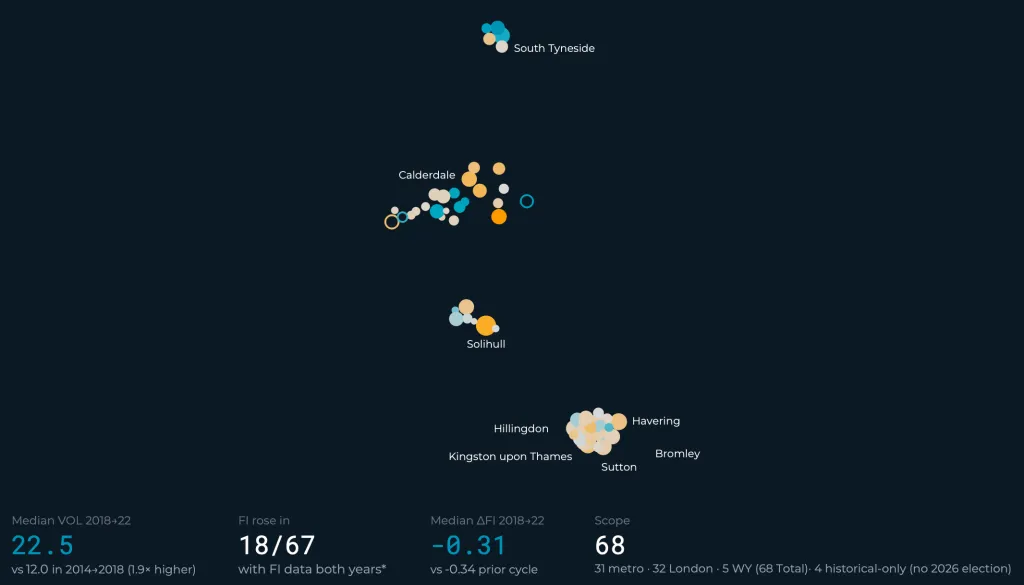
Between 2018 and 2022, median electoral volatility in English urban councils nearly doubled, rising from 12.0 to 22.5, indicating significant shifts in vote share. However, party system fragmentation did not increase, with the effective number of parties rising in only 18 of 67 councils and a median fragmentation change of -0.31. An initial finding suggesting widespread fragmentation was reversed after correcting a data categorization error that treated similar party labels as distinct parties.
- ▪Median electoral volatility in English urban councils increased from 12.0 in 2018 to 22.5 in 2022.
- ▪The effective number of parties increased in only 18 of 67 comparable councils, with a median fragmentation change of -0.31.
- ▪A data error treating labels like 'Labour Party' and 'Labour and Co-operative Party' as separate parties initially led to incorrect conclusions about rising fragmentation.
- ▪Correcting the error required normalizing party families before computing metrics, which reversed the original headline findings.
- ▪The analysis used data from the DCLEAPIL v1.0 dataset, aggregating ward-level results to authority-level metrics for 67 English councils.
Opening excerpt (first ~120 words) tap to expand
Data Science Churn Without Fragmentation: How a Party-Label Bug Reversed My Headline Finding A data quality case study from English local elections on categorical normalisation, metric validation, and why raw labels should never define analytical groups Obinna Iheanachor May 1, 2026 11 min read Share Between 2018 and 2022, English urban councils became nearly twice as volatile. Median volatility rose from 12.0 to 22.5. But the party system did not fragment. That distinction became visible only after fixing a categorical data bug. Here, volatility measures how much vote share moved between party families. Fragmentation measures how many effective parties competed.
…
Excerpt limited to ~120 words for fair-use compliance. The full article is at Towards Data Science.
Discussion
0 commentsMore from Towards Data Science