Clasp: A four-stage supply-chain attack pattern via emergency patches
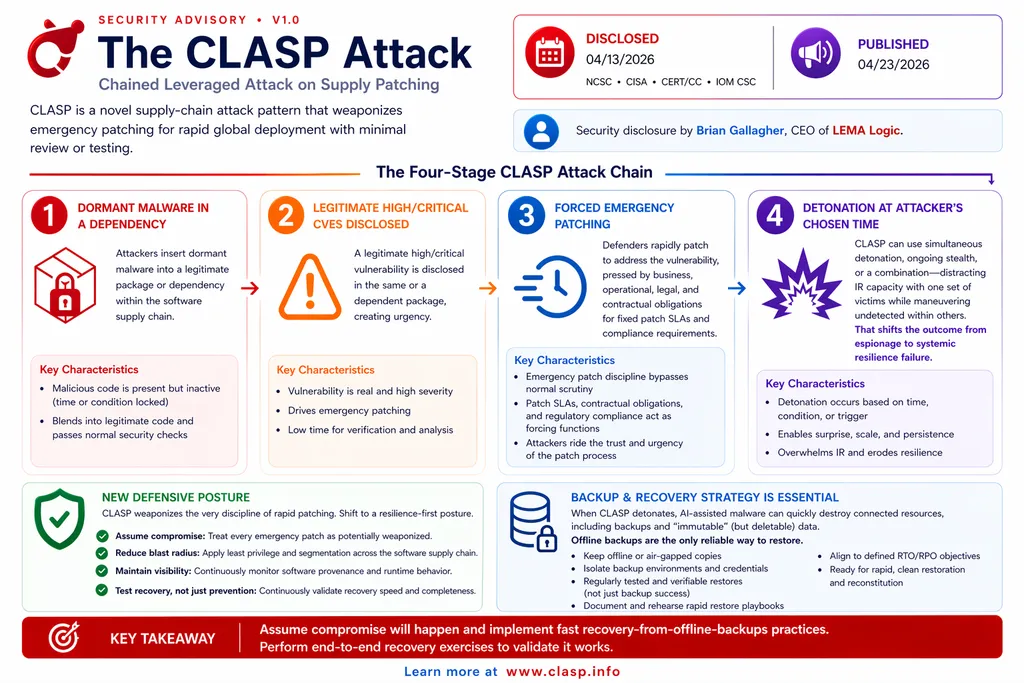
CLASP is a four-stage supply-chain attack that exploits emergency patching to rapidly deploy malware, with the patch itself acting as a diversion rather than the payload. The attack relies on dormant malicious code already merged into a codebase, which is activated after defenders apply a legitimate High/Critical CVE patch. The rise of AI models like Mythos and GPT-5.4-Cyber has accelerated vulnerability discovery and overwhelmed maintainers, making such attacks more feasible.
- ▪CLASP involves four stages: supply-chain compromise, legitimate CVE disclosure, emergency patching, and attacker-controlled payload detonation.
- ▪The malicious code is already in the codebase before the patch; the patch rush causes defenders to deploy it themselves.
- ▪AI models like Mythos and GPT-5.4-Cyber have enabled on-demand discovery of trigger vulnerabilities, increasing the risk of such attacks.
- ▪Over 99% of high/critical vulnerabilities identified by Mythos remain unpatched, creating a large attack surface.
- ▪Organizations are advised to maintain physical offline backups and conduct bare-metal recovery exercises to prepare for compromise.
Story provenance
Source · retrieval · rights · ranking — open for full record
inspect →
Story provenance
Attribution is not the same as permission. This drawer separates discovery metadata, excerpts, WeSearch-generated summaries, reuse status, and whether the publisher receives the visit. Nothing here claims a legal grant the publisher has not made.
Record
| Original publisher | Clasp |
| Canonical URL | https://www.clasp.info/ |
| Publication time | Tue, 28 Apr 2026 12:50:34 +0000 |
| Retrieval time | 2026-04-28T12:54:31.957Z |
| Last seen | 2026-04-28T12:54:31.957Z |
| Headline source | Publisher (no WeSearch rewrite) |
| Excerpt source | publisher body |
| Excerpt method | First ~120 words (~800 chars) of extracted publisher body, fair-use limited. |
| Summary | WeSearch · cerebras-chat (WeSearch summarizer) |
| Summary source text | contentText |
| Citation coverage | Summary is a WeSearch-generated derivative; primary citation is the original publisher URL. |
| Cluster | vgAm4hODUCEp |
| Cluster logic | Grouped by semantic title/content similarity across sources within a rolling window. Same-publisher template collisions are excluded from coverage comparison. |
| Ranking reason | Story pages are not engagement-ranked. Hub feeds use recency, with optional source-diversified chronological ordering (cap consecutive stories per source). No personalized ranking. |
| Publisher visit | Yes — open original |
| Substitutes article? | No — link-out required for full text |
Rights status (four layers)
WeSearch handling by dimension
| Indexing | May the item be indexed (stored, ranked, made findable)? | Allowed |
| Snippet | May a short excerpt of the publisher's text be shown? | Allowed |
| AI summary | May WeSearch generate its own short summary of the article? | Limited |
| Retrieval / RAG | May the content be exposed for third-party retrieval-augmented generation? | Not asserted |
| Model training | May the content be used to train AI models? | Not asserted |
| Commercial reuse | May the content be reused commercially? | Not permitted |
Basis: Derived from the published RSS/Atom feed. Contact: [email protected]. Reviewed: 2026-07-24.
Opening excerpt (first ~120 words) tap to expand
Security Advisory · v1.0 The CLASP Attack Organizations with the best patching processes are most vulnerable to CLASP and will be the first systems compromised. Chained Leveraged Attack on Supply Patching (CLASP) is a novel supply-chain attack pattern that weaponizes emergency patching for rapid global exploit deployment with minimal review or testing. The patch is the diversion, not the payload. The malicious code was already merged into the codebase, and the patch is forcing defenders to deploy it at speed. Disclosed 04/13/2026 · Published 04/23/2026 This has been made much easier with the release (and leaking) of Mythos and GPT-5.4-Cyber models.
…
Excerpt limited to ~120 words for fair-use compliance. The full article is at Clasp.
Discussion
0 commentsMore from Clasp