Commodore 128 Becomes Marine Vessel Tracker
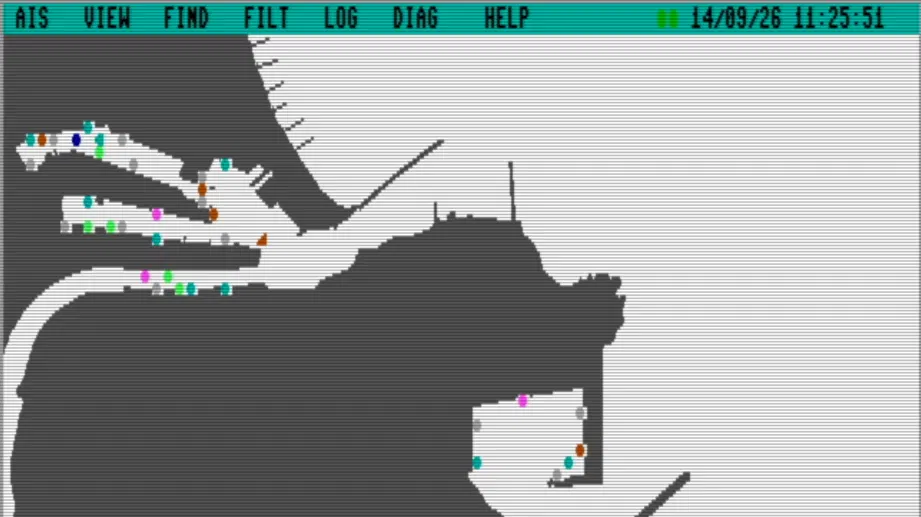
A team has developed a system that allows the vintage Commodore 128 computer to function as a marine vessel tracker using Automatic Identification System data. The project utilizes assembly code for data processing and BASIC for the graphical user interface to plot ship movements on a map. While the setup requires specific hardware expansions like a 512 KiB REU and VDC memory, it serves as an entertaining retrocomputing demonstration rather than a professional navigation tool.
- ▪The AIS4CBM project enables a Commodore 128 to display real-time vessel tracks from AIS maritime radio communications.
- ▪The system uses assembly code to parse serial data and BASIC 8 to render a graphical map of vessel positions.
- ▪Running the software requires a 512 KiB REU RAM expansion, 64 KiB VDC memory, and a SwiftLink compatible serial interface.
- ▪The project is intended as a fun hobbyist build similar to using an NES for ADS-B tracking, not for professional harbor management.
Hackaday files mainly under tech. We currently carry 448 of its stories.
Story provenance
Source · retrieval · rights · ranking — open for full record
inspect →
Story provenance
Attribution is not the same as permission. This drawer separates discovery metadata, excerpts, WeSearch-generated summaries, reuse status, and whether the publisher receives the visit. Nothing here claims a legal grant the publisher has not made.
Record
| Original publisher | Hackaday |
| Canonical URL | https://hackaday.com/2026/09/25/commodore-128-becomes-marine-vessel-tracker/ |
| Publication time | Fri, 25 Sep 2026 08:00:14 +0000 |
| Retrieval time | 2026-09-25T08:05:32.487Z |
| Last seen | 2026-09-25T08:05:32.487Z |
| Headline source | Publisher (no WeSearch rewrite) |
| Excerpt source | publisher body |
| Excerpt method | First ~120 words (~800 chars) of extracted publisher body, fair-use limited. |
| Summary | WeSearch · cerebras-chat (WeSearch summarizer) |
| Summary source text | contentText |
| Citation coverage | Summary is a WeSearch-generated derivative; primary citation is the original publisher URL. |
| Cluster | HVsKFn2pZ0d3 · 1 stories |
| Cluster logic | Grouped by semantic title/content similarity across sources within a rolling window. Same-publisher template collisions are excluded from coverage comparison. |
| Ranking reason | Story pages are not engagement-ranked. Hub feeds use recency, with optional source-diversified chronological ordering (cap consecutive stories per source). No personalized ranking. |
| Publisher visit | Yes — open original |
| Substitutes article? | No — link-out required for full text |
Rights status (four layers)
WeSearch handling by dimension
| Indexing | May the item be indexed (stored, ranked, made findable)? | Allowed |
| Snippet | May a short excerpt of the publisher's text be shown? | Allowed |
| AI summary | May WeSearch generate its own short summary of the article? | Limited |
| Retrieval / RAG | May the content be exposed for third-party retrieval-augmented generation? | Not asserted |
| Model training | May the content be used to train AI models? | Not asserted |
| Commercial reuse | May the content be reused commercially? | Not permitted |
Basis: Derived from the published RSS/Atom feed. Contact: [email protected]. Reviewed: 2026-07-24.
Opening excerpt (first ~120 words) tap to expand
Commodore 128 Becomes Marine Vessel Tracker No comments by: Zoe Skyforest September 25, 2026 Title: Copy Short Link: Copy The Automatic Identification System (AIS) is a maritime radio communications tool used to allow different vessels to identify each other and communicate their movements and other telemetry. You can readily view a variety of AIS trackers online. Alternatively, you could build your own, and display the data on a retrocomputer from 40-plus years ago. The concept is straightforward enough—it’s a Commodore 128 displaying vessel tracks from AIS data. The team behind AIS4CBM implemented this with assembly code to receive data over serial, parse and decode the AIS reports, and manage vessel data.
…
Excerpt limited to ~120 words for fair-use compliance. The full article is at Hackaday.
Discussion
0 commentsMore from Hackaday