Defeating Satellite Spoofing with Galileo’s Encryption
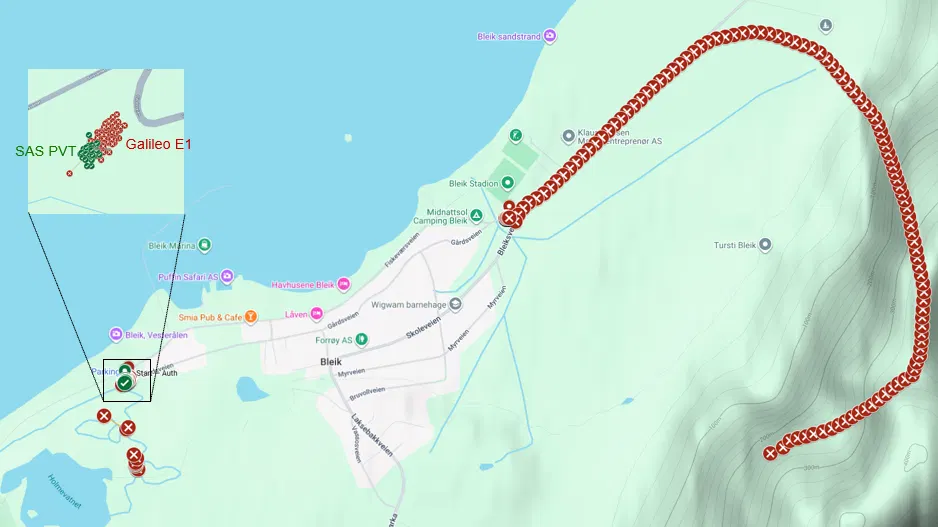
Galileo, Europe's global navigation satellite system, has successfully demonstrated its first cryptographically secured position fix under active spoofing conditions. The system utilizes a Signal Authentication System that encrypts spreading codes to allow receivers to verify the authenticity of satellite signals. This breakthrough was confirmed during the Jammertest event in Norway, where the European Space Agency maintained a stable lock despite interference attempts.
- ▪Galileo's Signal Authentication System encrypts signal spreading codes with a regularly changing secret key to prevent spoofing.
- ▪Receivers download encrypted codes in advance and use a separate decryption key transmitted by the satellite to verify the signal.
- ▪The European Space Agency successfully tested this technology at the Jammertest event in Andøya, Norway.
- ▪Most other GNSS systems, including GPS, currently lack verification measures and remain vulnerable to high-power false signals.
- ▪The demonstrated method could potentially be extended to other global navigation satellite systems in the future.
Hackaday files mainly under tech. We currently carry 468 of its stories.
Story provenance
Source · retrieval · rights · ranking — open for full record
inspect →
Story provenance
Attribution is not the same as permission. This drawer separates discovery metadata, excerpts, WeSearch-generated summaries, reuse status, and whether the publisher receives the visit. Nothing here claims a legal grant the publisher has not made.
Record
| Original publisher | Hackaday |
| Canonical URL | https://hackaday.com/2026/09/27/defeating-satellite-spoofing-with-galileos-encryption/ |
| Publication time | Sun, 27 Sep 2026 20:00:00 +0000 |
| Retrieval time | 2026-09-27T20:01:06.375Z |
| Last seen | 2026-09-27T20:01:06.375Z |
| Headline source | Publisher (no WeSearch rewrite) |
| Excerpt source | publisher body |
| Excerpt method | First ~120 words (~800 chars) of extracted publisher body, fair-use limited. |
| Summary | WeSearch · cerebras-chat (WeSearch summarizer) |
| Summary source text | contentText |
| Citation coverage | Summary is a WeSearch-generated derivative; primary citation is the original publisher URL. |
| Cluster | TYLQEEI6BjBJ · 1 stories |
| Cluster logic | Grouped by semantic title/content similarity across sources within a rolling window. Same-publisher template collisions are excluded from coverage comparison. |
| Ranking reason | Story pages are not engagement-ranked. Hub feeds use recency, with optional source-diversified chronological ordering (cap consecutive stories per source). No personalized ranking. |
| Publisher visit | Yes — open original |
| Substitutes article? | No — link-out required for full text |
Rights status (four layers)
WeSearch handling by dimension
| Indexing | May the item be indexed (stored, ranked, made findable)? | Allowed |
| Snippet | May a short excerpt of the publisher's text be shown? | Allowed |
| AI summary | May WeSearch generate its own short summary of the article? | Limited |
| Retrieval / RAG | May the content be exposed for third-party retrieval-augmented generation? | Not asserted |
| Model training | May the content be used to train AI models? | Not asserted |
| Commercial reuse | May the content be reused commercially? | Not permitted |
Basis: Derived from the published RSS/Atom feed. Contact: [email protected]. Reviewed: 2026-07-24.
Opening excerpt (first ~120 words) tap to expand
Defeating Satellite Spoofing With Galileo’s Encryption No comments by: Aaron Beckendorf September 27, 2026 Title: Copy Short Link: Copy Considering how important it is for everything from navigation to keeping clocks in sync, satellite navigation systems are surprisingly vulnerable to a variety of attacks, ranging from simple jamming to more sophisticated spoofing attacks. This may be changing, though, as Galileo, Europe’s GNSS, recently demonstrated its first cryptographically-secured position fix under spoofing conditions.
…
Excerpt limited to ~120 words for fair-use compliance. The full article is at Hackaday.
Discussion
0 commentsMore from Hackaday