Into the Omniverse: Manufacturing’s Simulation-First Era Has Arrived
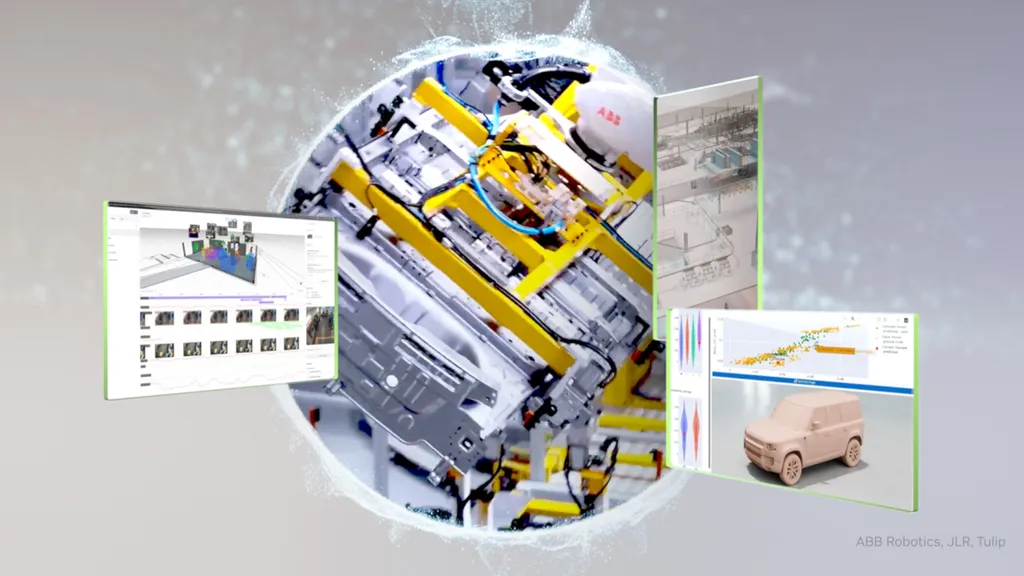
Manufacturing is entering a simulation-first era, shifting from traditional testing methods to high-fidelity simulations. This change is facilitated by OpenUSD, which allows for accurate synthetic training data for AI applications. Companies like ABB Robotics and JLR are already experiencing significant operational improvements through these advancements.
- ▪Manufacturers are moving away from real-world testing to high-fidelity simulations for AI training.
- ▪OpenUSD serves as the standard for reliable 3D asset transfer across various platforms.
- ▪ABB Robotics has achieved 99% accuracy in simulations, leading to reduced product introduction cycles and costs.
NVIDIA Blog files mainly under ai. We currently carry 18 of its stories.
Story provenance
Source · retrieval · rights · ranking — open for full record
inspect →
Attribution is not the same as permission. This drawer separates discovery metadata, excerpts, WeSearch-generated summaries, reuse status, and whether the publisher receives the visit. Nothing here claims a legal grant the publisher has not made.
Record
| Original publisher | NVIDIA Blog |
| Canonical URL | https://blogs.nvidia.com/blog/manufacturing-simulation-first/ |
| Publication time | Tue, 28 Apr 2026 13:00:33 +0000 |
| Retrieval time | 2026-04-28T13:04:31.927Z |
| Last seen | 2026-04-28T13:04:31.927Z |
| Headline source | Publisher (no WeSearch rewrite) |
| Excerpt source | publisher body |
| Excerpt method | First ~120 words (~800 chars) of extracted publisher body, fair-use limited. |
| Summary | WeSearch · cerebras-chat (WeSearch summarizer) |
| Summary source text | contentText |
| Citation coverage | Summary is a WeSearch-generated derivative; primary citation is the original publisher URL. |
| Cluster | pBeAp5cOQgJS |
| Cluster logic | Grouped by semantic title/content similarity across sources within a rolling window. Same-publisher template collisions are excluded from coverage comparison. |
| Ranking reason | Story pages are not engagement-ranked. Hub feeds use recency, with optional source-diversified chronological ordering (cap consecutive stories per source). No personalized ranking. |
| Publisher visit | Yes — open original |
| Substitutes article? | No — link-out required for full text |
Rights status (four layers)
WeSearch handling by dimension
| Indexing | May the item be indexed (stored, ranked, made findable)? | Allowed |
| Snippet | May a short excerpt of the publisher's text be shown? | Allowed |
| AI summary | May WeSearch generate its own short summary of the article? | Limited |
| Retrieval / RAG | May the content be exposed for third-party retrieval-augmented generation? | Not asserted |
| Model training | May the content be used to train AI models? | Not asserted |
| Commercial reuse | May the content be reused commercially? | Not permitted |
Basis: Derived from the published RSS/Atom feed. Contact: [email protected]. Reviewed: 2026-07-24.
Opening excerpt (first ~120 words) tap to expand
Into the Omniverse: Manufacturing’s Simulation-First Era Has Arrived April 28, 2026 by Bhoomi Gadhia 0 Comments Share Share This Article X Facebook LinkedIn Copy link Link copied! Editor’s note: This post is part of Into the Omniverse, a series focused on how developers, 3D practitioners, and enterprises can transform their workflows using the latest advances in OpenUSD and NVIDIA Omniverse. Manufacturing’s traditional design-build-test cycle rested on a single assumption: Real-world testing was the only reliable test environment. That assumption is now shifting. Today, high-fidelity simulation produces synthetic training data accurate enough for production-grade AI. This is enabling perception systems, reasoning models and agentic workflows to excel in live factory environments.
…
Excerpt limited to ~120 words for fair-use compliance. The full article is at NVIDIA Blog.
Discussion
0 commentsMore from NVIDIA Blog