Is Alien Life Hiding in Plain Sight, Right Here in Our Solar System?
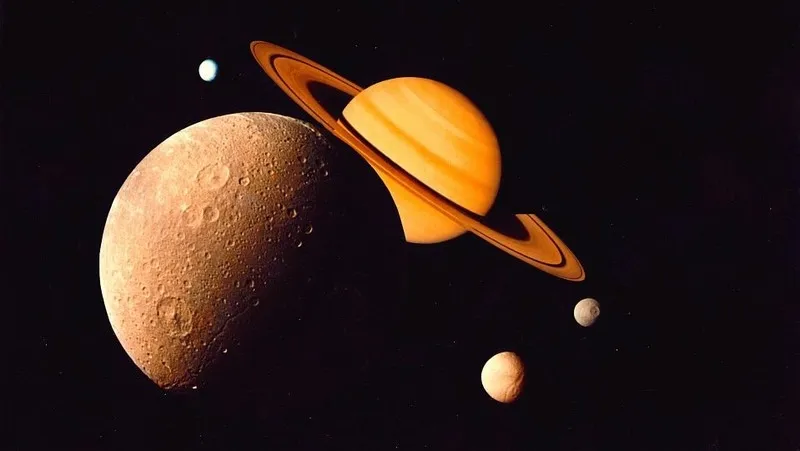
Saturn's moons, particularly Titan and Enceladus, have revealed surprising potential for supporting life. The Cassini mission provided extensive data, showing Titan's unique atmosphere and liquid methane lakes. These findings challenge previous notions about where life could exist in our solar system.
- ▪Cassini spent thirteen years studying Saturn and its moons, revealing details about their environments.
- ▪Titan has a thick atmosphere and vast lakes of liquid methane, making it the most Earth-like celestial body discovered.
- ▪There may be a subsurface ocean of salty liquid water beneath Titan's icy crust.
Literary Hub (LitHub) files mainly under books. We currently carry 79 of its stories.
Story provenance
Source · retrieval · rights · ranking — open for full record
inspect →
Story provenance
Attribution is not the same as permission. This drawer separates discovery metadata, excerpts, WeSearch-generated summaries, reuse status, and whether the publisher receives the visit. Nothing here claims a legal grant the publisher has not made.
Record
| Original publisher | Literary Hub |
| Canonical URL | https://lithub.com/is-alien-life-hiding-in-plain-sight-right-here-in-our-solar-system/ |
| Publication time | Fri, 22 May 2026 08:59:41 +0000 |
| Retrieval time | 2026-05-22T09:02:01.206Z |
| Last seen | 2026-05-22T09:02:01.206Z |
| Headline source | Publisher (no WeSearch rewrite) |
| Excerpt source | publisher body |
| Excerpt method | First ~120 words (~800 chars) of extracted publisher body, fair-use limited. |
| Summary | WeSearch · cerebras-chat (WeSearch summarizer) |
| Summary source text | contentText |
| Citation coverage | Summary is a WeSearch-generated derivative; primary citation is the original publisher URL. |
| Cluster | BHTv69P6TpZ4 |
| Cluster logic | Grouped by semantic title/content similarity across sources within a rolling window. Same-publisher template collisions are excluded from coverage comparison. |
| Ranking reason | Story pages are not engagement-ranked. Hub feeds use recency, with optional source-diversified chronological ordering (cap consecutive stories per source). No personalized ranking. |
| Publisher visit | Yes — open original |
| Substitutes article? | No — link-out required for full text |
Rights status (four layers)
WeSearch handling by dimension
| Indexing | May the item be indexed (stored, ranked, made findable)? | Allowed |
| Snippet | May a short excerpt of the publisher's text be shown? | Allowed |
| AI summary | May WeSearch generate its own short summary of the article? | Limited |
| Retrieval / RAG | May the content be exposed for third-party retrieval-augmented generation? | Not asserted |
| Model training | May the content be used to train AI models? | Not asserted |
| Commercial reuse | May the content be reused commercially? | Not permitted |
Basis: Derived from the published RSS/Atom feed. Contact: [email protected]. Reviewed: 2026-07-24.
Opening excerpt (first ~120 words) tap to expand
The grandeur of Saturn is stunning to behold when viewed through a telescope. Possibly the most iconic and easily identifiable member of our solar system, this “ringed planet” has a volume equivalent to 760 Earths and such astonishingly low density that the planet could even float on water. Until two decades ago, few missions had visited Saturn, although Pioneer 11 and the Voyager probes briefly flew by and gave us some stunning imagery and reconnaissance to identify particular areas of interest.Article continues after advertisement It wasn’t until 2004 that the dedicated space probe Cassini arrived at the planet.
…
Excerpt limited to ~120 words for fair-use compliance. The full article is at Literary Hub.
Discussion
0 commentsMore from Literary Hub