Marilyn Monroe Was a Voracious Reader, Despite Her Near-Debilitating Imposter Syndrome
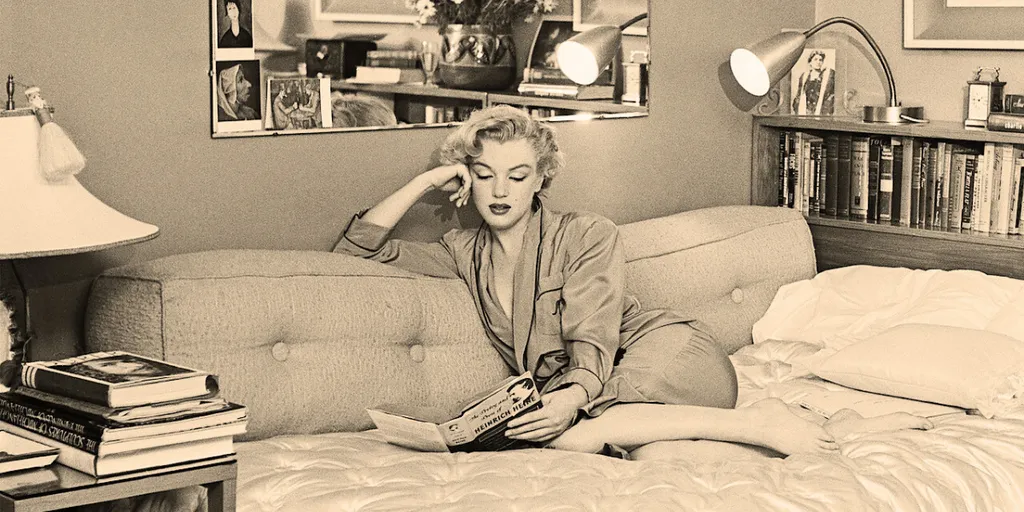
Marilyn Monroe's literary pursuits were a means to combat her feelings of inadequacy and impostor syndrome. Despite her fame, she struggled with self-doubt due to a lack of support from family and partners. Her relationships often exacerbated these feelings, particularly with her husband Arthur Miller, whose doubts about her intelligence deeply affected her self-worth.
- ▪Marilyn Monroe faced significant self-doubt due to a lack of supportive relationships in her life.
- ▪Her reading and literary interests were efforts to overcome perceived inadequacies.
- ▪Monroe's marriage to Arthur Miller contributed to her feelings of inferiority when she discovered his doubts about her intelligence.
Literary Hub (LitHub) files mainly under books. We currently carry 79 of its stories.
Story provenance
Source · retrieval · rights · ranking — open for full record
inspect →
Story provenance
Attribution is not the same as permission. This drawer separates discovery metadata, excerpts, WeSearch-generated summaries, reuse status, and whether the publisher receives the visit. Nothing here claims a legal grant the publisher has not made.
Record
| Original publisher | Literary Hub |
| Canonical URL | https://lithub.com/marilyn-monroe-was-a-voracious-reader-despite-her-near-debilitating-imposter-syndrome/ |
| Publication time | Tue, 26 May 2026 09:00:24 +0000 |
| Retrieval time | 2026-05-26T09:07:47.290Z |
| Last seen | 2026-05-26T09:07:47.290Z |
| Headline source | Publisher (no WeSearch rewrite) |
| Excerpt source | publisher body |
| Excerpt method | First ~120 words (~800 chars) of extracted publisher body, fair-use limited. |
| Summary | WeSearch · cerebras-chat (WeSearch summarizer) |
| Summary source text | contentText |
| Citation coverage | Summary is a WeSearch-generated derivative; primary citation is the original publisher URL. |
| Cluster | tx9177JqUfC8 |
| Cluster logic | Grouped by semantic title/content similarity across sources within a rolling window. Same-publisher template collisions are excluded from coverage comparison. |
| Ranking reason | Story pages are not engagement-ranked. Hub feeds use recency, with optional source-diversified chronological ordering (cap consecutive stories per source). No personalized ranking. |
| Publisher visit | Yes — open original |
| Substitutes article? | No — link-out required for full text |
Rights status (four layers)
WeSearch handling by dimension
| Indexing | May the item be indexed (stored, ranked, made findable)? | Allowed |
| Snippet | May a short excerpt of the publisher's text be shown? | Allowed |
| AI summary | May WeSearch generate its own short summary of the article? | Limited |
| Retrieval / RAG | May the content be exposed for third-party retrieval-augmented generation? | Not asserted |
| Model training | May the content be used to train AI models? | Not asserted |
| Commercial reuse | May the content be reused commercially? | Not permitted |
Basis: Derived from the published RSS/Atom feed. Contact: [email protected]. Reviewed: 2026-07-24.
Opening excerpt (first ~120 words) tap to expand
If someone tells you that you are stupid and dumb enough times, chances are you will start to believe it. If you are someone with no stable and loving family to fall back on, or no partner who believes in you, or no close friends who are in your corner, your self-worth relies entirely on the strength of your self-belief. This can be difficult to sustain, and it is understandable that some form of self-doubt would begin to creep in. Why is impostor syndrome an important point to consider when thinking about the literary life of Marilyn Monroe? The answer is that Marilyn’s reading formed a concerted effort to overcome any inadequacies she perceived in her-self. She strove for progressive self-betterment with an engaged and inquisitive mind.
…
Excerpt limited to ~120 words for fair-use compliance. The full article is at Literary Hub.
Discussion
0 commentsMore from Literary Hub