
Nasa heads to Scottish Highlands in its search for life on Mars
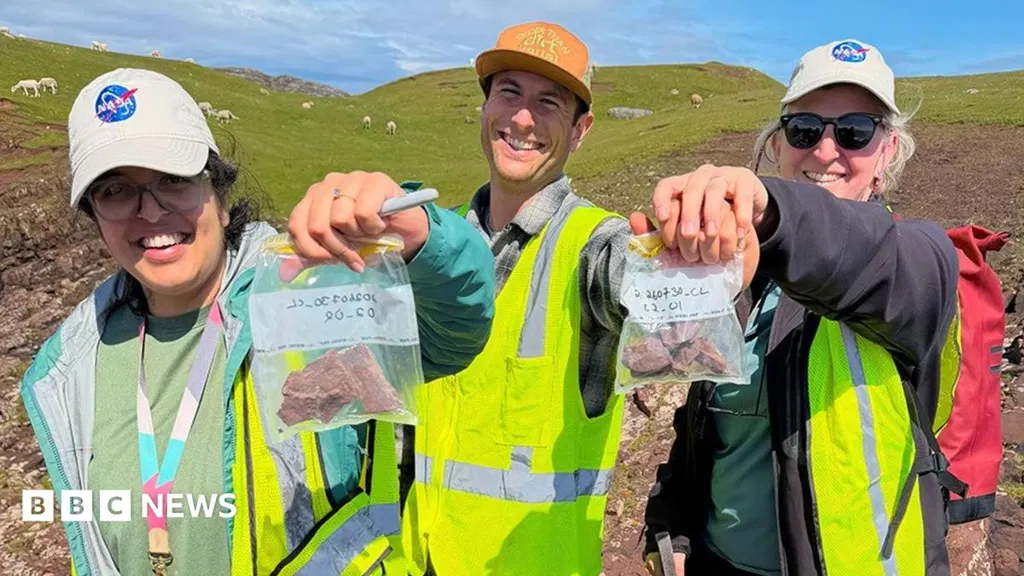
NASA scientists recently collected rock samples from the Scottish Highlands to aid in the search for evidence of past life on Mars. The expedition focused on the Stoer Formation near Clachtoll, where geological conditions resemble ancient Martian lakes and rivers. By studying these Earth rocks, researchers aim to better understand how biosignatures are preserved and detected in similar Martian environments.
- ▪NASA's Perseverance rover recently detected potential biosignatures on Mars that may have been created by ancient microbes.
- ▪Scientists from NASA's Goddard Instrument Field Team, along with experts from the universities of Glasgow and Cambridge, sampled rocks from the Stoer Formation in Assynt.
- ▪The rocks at Clachtoll are approximately 1.2 billion years old and formed in environments comparable to ancient Martian water bodies.
- ▪Previous research has also utilized Scottish geology, such as the Torridon area, to test technology for detecting Martian life.
- ▪Several locations on Mars, including Torridon and Siccar Point, have been named after specific sites in Scotland.
BBC News — Science publishes from United Kingdom and files mainly under science. We currently carry 294 of its stories.
Story provenance
Source · retrieval · rights · ranking — open for full record
inspect →
Story provenance
Attribution is not the same as permission. This drawer separates discovery metadata, excerpts, WeSearch-generated summaries, reuse status, and whether the publisher receives the visit. Nothing here claims a legal grant the publisher has not made.
Record
| Original publisher | BBC News — Science |
| Canonical URL | https://www.bbc.co.uk/news/articles/c5gmr3309p7jo?at_medium=RSS&at_campaign=rss |
| Publication time | Thu, 01 Oct 2026 08:57:33 GMT |
| Retrieval time | 2026-10-01T09:02:31.919Z |
| Last seen | 2026-10-01T09:02:31.919Z |
| Headline source | Publisher (no WeSearch rewrite) |
| Excerpt source | publisher body |
| Excerpt method | First ~120 words (~800 chars) of extracted publisher body, fair-use limited. |
| Summary | WeSearch · cerebras-chat (WeSearch summarizer) |
| Summary source text | contentText |
| Citation coverage | Summary is a WeSearch-generated derivative; primary citation is the original publisher URL. |
| Cluster | YNqkd-Ca5Zg0 · 1 stories |
| Cluster logic | Grouped by semantic title/content similarity across sources within a rolling window. Same-publisher template collisions are excluded from coverage comparison. |
| Ranking reason | Story pages are not engagement-ranked. Hub feeds use recency, with optional source-diversified chronological ordering (cap consecutive stories per source). No personalized ranking. |
| Publisher visit | Yes — open original |
| Substitutes article? | No — link-out required for full text |
Rights status (four layers)
WeSearch handling by dimension
| Indexing | May the item be indexed (stored, ranked, made findable)? | Allowed |
| Snippet | May a short excerpt of the publisher's text be shown? | Allowed |
| AI summary | May WeSearch generate its own short summary of the article? | Limited |
| Retrieval / RAG | May the content be exposed for third-party retrieval-augmented generation? | Not asserted |
| Model training | May the content be used to train AI models? | Not asserted |
| Commercial reuse | May the content be reused commercially? | Not permitted |
Basis: Derived from the published RSS/Atom feed. Contact: [email protected]. Reviewed: 2026-07-24.
Opening excerpt (first ~120 words) tap to expand
Nasa heads to Scottish Highlands in its search for life on MarsImage source, NASA/Pedro CotaImage caption, The Nasa-led team of scientists took samples of ancient rock from the north-west HighlandsBySteven McKenzieHighlands and Islands reporterPublished3 minutes agoNasa scientists are studying rocks in the Scottish Highlands to help them understand if there was once life on Mars.The US space agency announced last year that its Perseverance rover had found potential biosignatures, markings on rocks possibly made by ancient microbes.This summer, scientists took samples from a geological feature called the Stoer Formation, external around Clachtoll, in Assynt, in the north-west Highlands.Nasa said the area's rocks formed in environments comparable to ancient Martian lakes and rivers, but…
Excerpt limited to ~120 words for fair-use compliance. The full article is at BBC News — Science.
Discussion
0 commentsMore from BBC News — Science


