
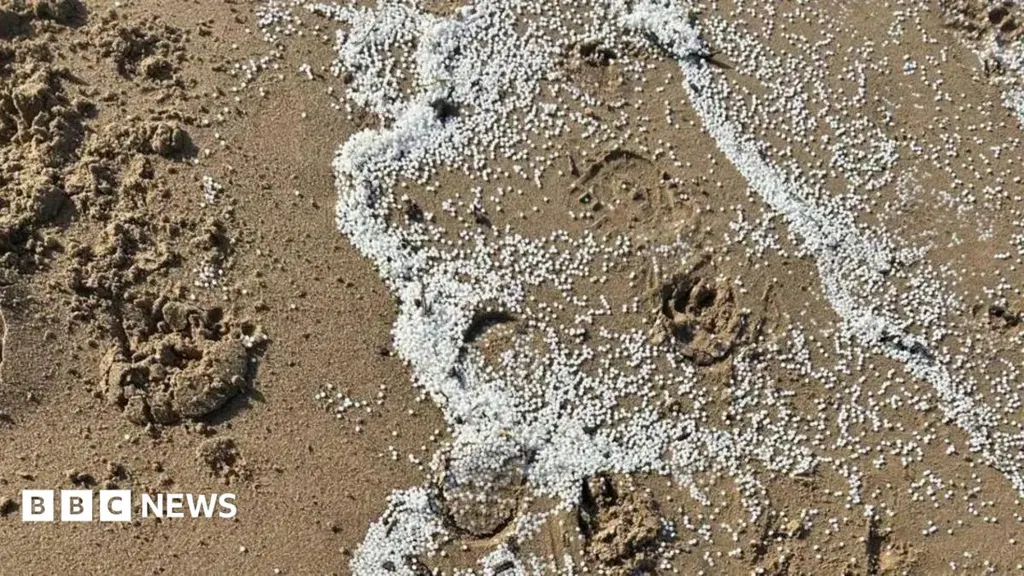
Only 28% of nurdles 'recovered', researchers say
Researchers estimate that only 28% of the plastic nurdles spilled into the River Tyne following a ship collision have been recovered. The remaining particles are expected to continue washing up on beaches in the future as they disperse into the North Sea. Local officials have commissioned an independent review and are calling for changes to international regulations regarding the transport of plastic nurdles.
- ▪Approximately 18 tonnes of plastic nurdles spilled into the River Tyne after a ship collision at the Port of Tyne in July.
- ▪Volunteers have recovered only 5.14 tonnes of the spill despite spending thousands of hours clearing beaches across the region.
- ▪Scientists from Newcastle University and Cefas state that nurdles have likely dispersed beyond the Tyne estuary into the North Sea.
- ▪North East mayor Kim McGuinness has commissioned an independent review into the response and supports calls for stricter international transport rules.
- ▪STAC advised that complete recovery of every nurdle is not achievable and that ongoing monitoring is essential.
BBC News — Science publishes from United Kingdom and files mainly under science. We currently carry 289 of its stories.
Story provenance
Source · retrieval · rights · ranking — open for full record
inspect →
Story provenance
Attribution is not the same as permission. This drawer separates discovery metadata, excerpts, WeSearch-generated summaries, reuse status, and whether the publisher receives the visit. Nothing here claims a legal grant the publisher has not made.
Record
| Original publisher | BBC News — Science |
| Canonical URL | https://www.bbc.co.uk/news/articles/c5zjzr4rrl8lo?at_medium=RSS&at_campaign=rss |
| Publication time | Wed, 30 Sep 2026 12:16:06 GMT |
| Retrieval time | 2026-09-30T12:17:01.495Z |
| Last seen | 2026-09-30T12:17:01.495Z |
| Headline source | Publisher (no WeSearch rewrite) |
| Excerpt source | publisher body |
| Excerpt method | First ~120 words (~800 chars) of extracted publisher body, fair-use limited. |
| Summary | WeSearch · cerebras-chat (WeSearch summarizer) |
| Summary source text | contentText |
| Citation coverage | Summary is a WeSearch-generated derivative; primary citation is the original publisher URL. |
| Cluster | ELq-e0m7Fa9H · 1 stories |
| Cluster logic | Grouped by semantic title/content similarity across sources within a rolling window. Same-publisher template collisions are excluded from coverage comparison. |
| Ranking reason | Story pages are not engagement-ranked. Hub feeds use recency, with optional source-diversified chronological ordering (cap consecutive stories per source). No personalized ranking. |
| Publisher visit | Yes — open original |
| Substitutes article? | No — link-out required for full text |
Rights status (four layers)
WeSearch handling by dimension
| Indexing | May the item be indexed (stored, ranked, made findable)? | Allowed |
| Snippet | May a short excerpt of the publisher's text be shown? | Allowed |
| AI summary | May WeSearch generate its own short summary of the article? | Limited |
| Retrieval / RAG | May the content be exposed for third-party retrieval-augmented generation? | Not asserted |
| Model training | May the content be used to train AI models? | Not asserted |
| Commercial reuse | May the content be reused commercially? | Not permitted |
Basis: Derived from the published RSS/Atom feed. Contact: [email protected]. Reviewed: 2026-07-24.
Opening excerpt (first ~120 words) tap to expand
Only 28% of nurdles 'recovered', researchers sayImage caption, Millions of plastic nurdles washed up on beaches following the ship collisionByDan HallNorth East and CumbriaPublishedJust nowOnly 28% of nurdles which spilled into a river have been recovered and are expected to continue washing up on beaches in the future, scientists have calculated.Almost 18 tonnes of plastic nurdles are estimated to have spilled into the River Tyne after a collision between ships at the Port of Tyne in July.However, only 5.14 tonnes have been recovered despite volunteers spending thousands of hours clearing beaches across the region, work by Newcastle University and the Centre for Environment, Fisheries and Aquaculture Science (Cefas) found.South Tyneside Council's director of community operations Gary…
Excerpt limited to ~120 words for fair-use compliance. The full article is at BBC News — Science.
Discussion
0 commentsMore from BBC News — Science


