No GPU, No Problem: Flagship LLMs on a GPU-less Teenaged Server
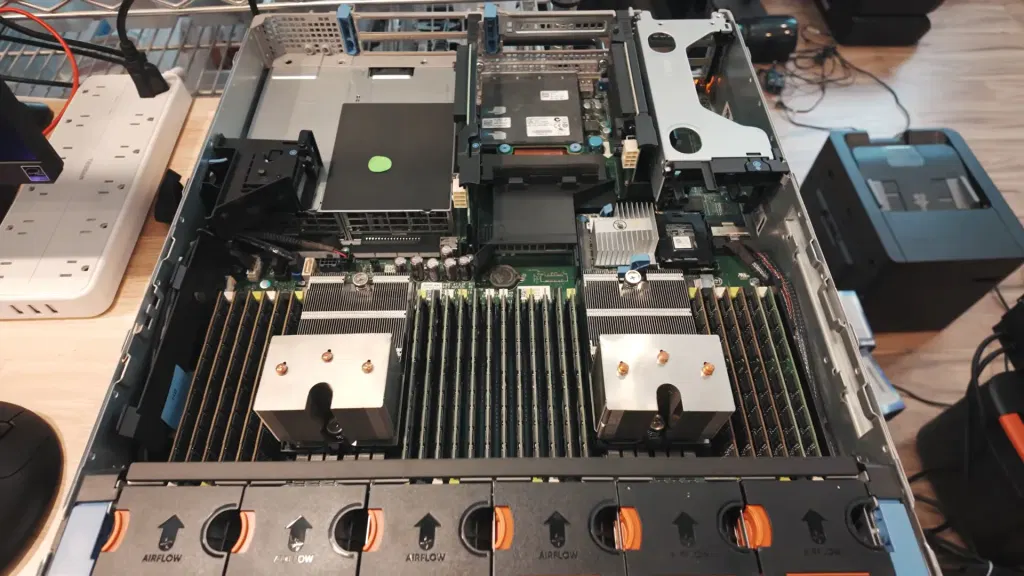
A content creator demonstrated that flagship large language models can run on a 14-year-old server without a GPU by utilizing 348 GB of DDR3 system memory. The setup achieves a maximum speed of four tokens per second due to the limitations of the twin Xeon processors and lack of modern instruction sets. While not suitable for real-time interaction, the configuration offers a viable option for batch processing tasks on affordable second-hand hardware.
- ▪The experiment used a 14-year-old Dell PowerEdge R720 server equipped with twin Xeon processors and 348 GB of DDR3 memory.
- ▪Flagship models such as GLM 5.3 Flash and Qwen 3.8 variants were successfully run on the system without any GPU.
- ▪The maximum performance achieved was approximately four tokens per second, limited by the available 20 threads and older processor architecture.
- ▪The creator estimates the cost of the second-hand hardware to be around $600, making it an accessible option for specific batch-processing workloads.
Hackaday files mainly under tech. We currently carry 402 of its stories.
Story provenance
Source · retrieval · rights · ranking — open for full record
inspect →
Story provenance
Attribution is not the same as permission. This drawer separates discovery metadata, excerpts, WeSearch-generated summaries, reuse status, and whether the publisher receives the visit. Nothing here claims a legal grant the publisher has not made.
Record
| Original publisher | Hackaday |
| Canonical URL | https://hackaday.com/2026/09/20/no-gpu-no-problem-flagship-llms-on-a-gpu-less-teenaged-server/ |
| Publication time | Sun, 20 Sep 2026 08:00:12 +0000 |
| Retrieval time | 2026-09-20T08:03:48.800Z |
| Last seen | 2026-09-20T08:03:48.800Z |
| Headline source | Publisher (no WeSearch rewrite) |
| Excerpt source | publisher body |
| Excerpt method | First ~120 words (~800 chars) of extracted publisher body, fair-use limited. |
| Summary | WeSearch · cerebras-chat (WeSearch summarizer) |
| Summary source text | contentText |
| Citation coverage | Summary is a WeSearch-generated derivative; primary citation is the original publisher URL. |
| Cluster | N3w8e6dixsOg · 1 stories |
| Cluster logic | Grouped by semantic title/content similarity across sources within a rolling window. Same-publisher template collisions are excluded from coverage comparison. |
| Ranking reason | Story pages are not engagement-ranked. Hub feeds use recency, with optional source-diversified chronological ordering (cap consecutive stories per source). No personalized ranking. |
| Publisher visit | Yes — open original |
| Substitutes article? | No — link-out required for full text |
Rights status (four layers)
WeSearch handling by dimension
| Indexing | May the item be indexed (stored, ranked, made findable)? | Allowed |
| Snippet | May a short excerpt of the publisher's text be shown? | Allowed |
| AI summary | May WeSearch generate its own short summary of the article? | Limited |
| Retrieval / RAG | May the content be exposed for third-party retrieval-augmented generation? | Not asserted |
| Model training | May the content be used to train AI models? | Not asserted |
| Commercial reuse | May the content be reused commercially? | Not permitted |
Basis: Derived from the published RSS/Atom feed. Contact: [email protected]. Reviewed: 2026-07-24.
Opening excerpt (first ~120 words) tap to expand
No GPU, No Problem: Flagship LLMs On A GPU-less Teenaged Server No comments by: Tyler August September 20, 2026 Title: Copy Short Link: Copy There are lots of reasons to run LLMs locally, from privacy concerns to just wanting to futz about with the technology, but if you want to run the big models, the standard logic is that you need big money for lots and lots of VRAM. [MattMo] is calling that into question with his recent video — embedded below, naturally — in which he gets GLM 5.3 Flash, Qwen 3.8 Flash and Qwen 3.8 27B all running on a 14-year-old server without a single GPU. The secret, if you can call it that, is that they aren’t running very fast: four tokens per second was about the max.
…
Excerpt limited to ~120 words for fair-use compliance. The full article is at Hackaday.
Discussion
0 commentsMore from Hackaday