Pentagon mulls plan to outsource warship design and building to Korea, Japan
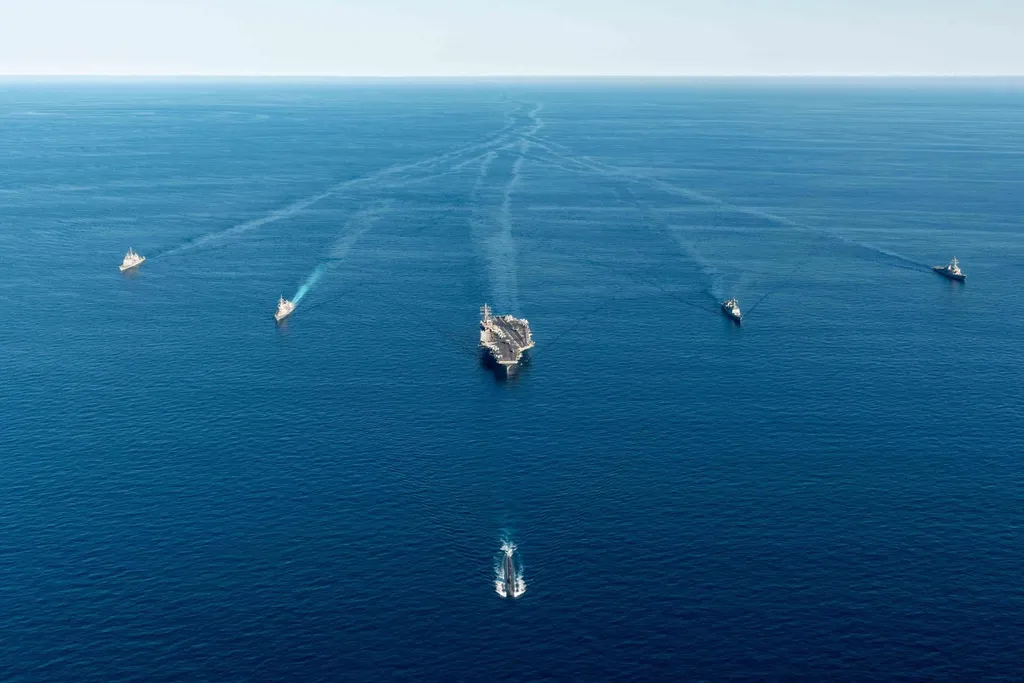
The Pentagon is exploring the possibility of outsourcing warship design and construction to Korea and Japan, with a proposed $1.85 billion feasibility study included in the 2027 budget. This initiative aims to address delays and capacity issues in U.S. shipbuilding while potentially acquiring advanced foreign designs. If implemented, it would mark the first major purchase of surface combatants from foreign partners since World War II.
- ▪The feasibility study will assess the adoption or co-production of advanced hulls like Japan's Mogami-class and Korea's Daegu-class frigates.
- ▪The U.S. Navy is facing significant production challenges, including labor shortages and cost overruns.
- ▪Any foreign involvement in U.S. shipbuilding would require a presidential waiver and could face opposition from domestic stakeholders.
2 outlets in our directory ran this story, first to last over 3 hours. All of the coverage we found sits in one bucket: centre. That one-sidedness is itself worth noticing.
- ▪ Pentagon mulls plan to outsource warship design and building to South Korea, Japan — South China Morning Post
Korea Times publishes from South Korea and files mainly under world. We currently carry 375 of its stories.
Story provenance
Source · retrieval · rights · ranking — open for full record
inspect →
Attribution is not the same as permission. This drawer separates discovery metadata, excerpts, WeSearch-generated summaries, reuse status, and whether the publisher receives the visit. Nothing here claims a legal grant the publisher has not made.
Record
| Original publisher | Korea Times |
| Canonical URL | https://www.koreatimes.co.kr/world/20260428/pentagon-mulls-plan-to-outsource-warship-design-and-building-to-korea-japan?utm_source=rss |
| Publication time | Tue, 28 Apr 2026 04:17:03 GMT |
| Retrieval time | 2026-04-28T04:22:06.772Z |
| Last seen | 2026-04-28T04:22:06.772Z |
| Headline source | Publisher (no WeSearch rewrite) |
| Excerpt source | publisher body |
| Excerpt method | First ~120 words (~800 chars) of extracted publisher body, fair-use limited. |
| Summary | WeSearch · cerebras-chat (WeSearch summarizer) |
| Summary source text | contentText |
| Citation coverage | Summary is a WeSearch-generated derivative; primary citation is the original publisher URL. |
| Cluster | IN5jBgAH-No0 · 2 stories |
| Cluster logic | Grouped by semantic title/content similarity across sources within a rolling window. Same-publisher template collisions are excluded from coverage comparison. |
| Ranking reason | Story pages are not engagement-ranked. Hub feeds use recency, with optional source-diversified chronological ordering (cap consecutive stories per source). No personalized ranking. |
| Publisher visit | Yes — open original |
| Substitutes article? | No — link-out required for full text |
Rights status (four layers)
WeSearch handling by dimension
| Indexing | May the item be indexed (stored, ranked, made findable)? | Allowed |
| Snippet | May a short excerpt of the publisher's text be shown? | Allowed |
| AI summary | May WeSearch generate its own short summary of the article? | Limited |
| Retrieval / RAG | May the content be exposed for third-party retrieval-augmented generation? | Not asserted |
| Model training | May the content be used to train AI models? | Not asserted |
| Commercial reuse | May the content be reused commercially? | Not permitted |
Basis: Derived from the published RSS/Atom feed. Contact: [email protected]. Reviewed: 2026-07-24.
Opening excerpt (first ~120 words) tap to expand
Warships from Korea, the United States and Japan participate in an anti-submarine exercise in the East Sea in this Sept. 30, 2022 file photo. Courtesy of ROK NavyThe Pentagon is considering outsourcing warship design and building to Korea and Japan with a proposed $1.85 billion feasibility study into the project, according to U.S. media reports.The study — included in the 2027 budget — will look at the feasibility of adopting or co-producing advanced hulls such as Japan’s Mogami-class and Korea’s Daegu-class frigates to supplement the U.S. Navy’s overstretched production lines, USNI News reported on Friday.If the plan goes ahead it will be the first time the U.S.
…
Excerpt limited to ~120 words for fair-use compliance. The full article is at Korea Times.
Discussion
0 commentsMore from Korea Times