Ski Lift Removes Mice from Chicken Coop
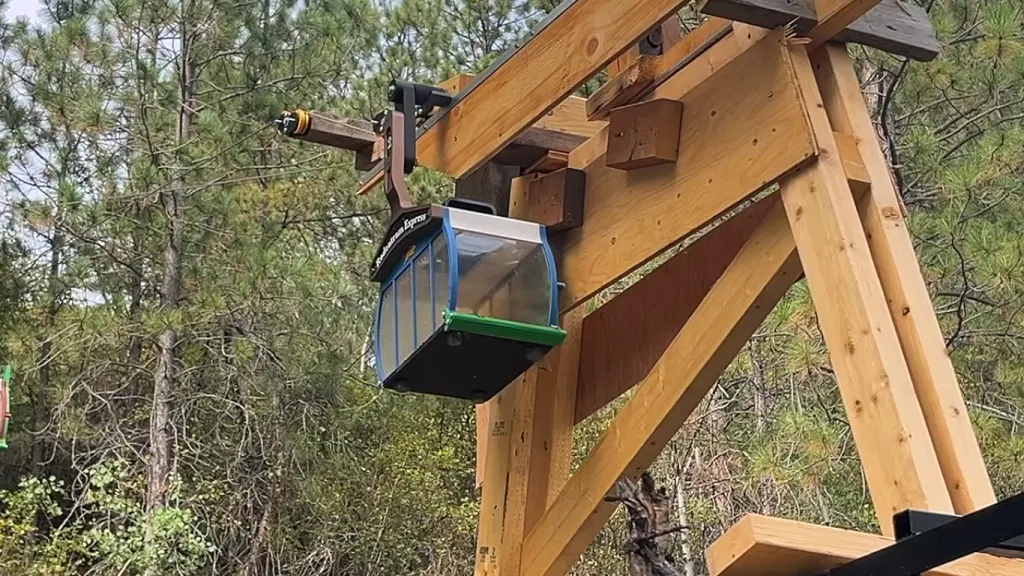
A hobbyist constructed a semi-automated ski lift system to humanely remove mice from his chicken coop. The device uses 3D-printed gondolas that act as traps to capture rodents and transport them down a hill for release. While the effectiveness of this method compared to traditional trapping is still unknown, it provides a creative and less labor-intensive solution for pest management.
- ▪The creator built a ski lift system to transport trapped mice away from his chicken coop to reduce the need for repeated manual trapping.
- ▪The gondolas are 3D-printed with acrylic windows and function as both the mousetrap and the transport vehicle.
- ▪Mice are released at the bottom of the hill onto a pile of brush via an automatic trap door mechanism.
- ▪The lift structure was constructed from wood and miscellaneous parts found on the property.
- ▪The author notes that it is too early to determine if this method is more effective than traditional pest control strategies.
Hackaday files mainly under tech. We currently carry 406 of its stories.
Story provenance
Source · retrieval · rights · ranking — open for full record
inspect →
Story provenance
Attribution is not the same as permission. This drawer separates discovery metadata, excerpts, WeSearch-generated summaries, reuse status, and whether the publisher receives the visit. Nothing here claims a legal grant the publisher has not made.
Record
| Original publisher | Hackaday |
| Canonical URL | https://hackaday.com/2026/09/20/ski-lift-removes-mice-from-chicken-coop/ |
| Publication time | Sun, 20 Sep 2026 20:00:00 +0000 |
| Retrieval time | 2026-09-20T20:03:47.381Z |
| Last seen | 2026-09-20T20:03:47.381Z |
| Headline source | Publisher (no WeSearch rewrite) |
| Excerpt source | publisher body |
| Excerpt method | First ~120 words (~800 chars) of extracted publisher body, fair-use limited. |
| Summary | WeSearch · cerebras-chat (WeSearch summarizer) |
| Summary source text | contentText |
| Citation coverage | Summary is a WeSearch-generated derivative; primary citation is the original publisher URL. |
| Cluster | 9QK-envxK_X- · 1 stories |
| Cluster logic | Grouped by semantic title/content similarity across sources within a rolling window. Same-publisher template collisions are excluded from coverage comparison. |
| Ranking reason | Story pages are not engagement-ranked. Hub feeds use recency, with optional source-diversified chronological ordering (cap consecutive stories per source). No personalized ranking. |
| Publisher visit | Yes — open original |
| Substitutes article? | No — link-out required for full text |
Rights status (four layers)
WeSearch handling by dimension
| Indexing | May the item be indexed (stored, ranked, made findable)? | Allowed |
| Snippet | May a short excerpt of the publisher's text be shown? | Allowed |
| AI summary | May WeSearch generate its own short summary of the article? | Limited |
| Retrieval / RAG | May the content be exposed for third-party retrieval-augmented generation? | Not asserted |
| Model training | May the content be used to train AI models? | Not asserted |
| Commercial reuse | May the content be reused commercially? | Not permitted |
Basis: Derived from the published RSS/Atom feed. Contact: [email protected]. Reviewed: 2026-07-24.
Opening excerpt (first ~120 words) tap to expand
Ski Lift Removes Mice From Chicken Coop No comments by: Bryan Cockfield September 20, 2026 Title: Copy Short Link: Copy Getting rid of rodents like squirrels, mice, or groundhogs is a lot like digging a hole on the beach. No matter how much you remove, it’ll always fill back in. So, while [Super Valid Designs] could keep trapping and “removing” the mice in his chicken coop, more will always work their way back in. His theory is that removing them live from the chicken coop and placing them some distance away will be more effective, and with this semi-automated ski lift that traps them and carts them off, it might end up being less work too. The build comes to us in roughly two parts.
…
Excerpt limited to ~120 words for fair-use compliance. The full article is at Hackaday.
Discussion
0 commentsMore from Hackaday