Smelting Bog Ore As It Should Be Done
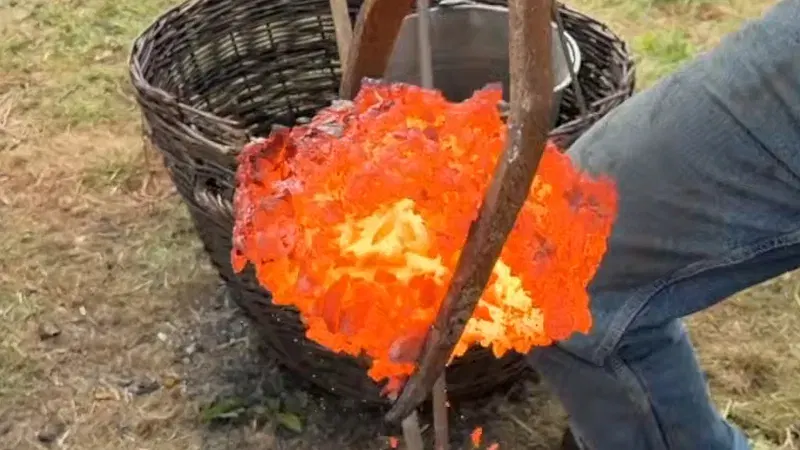
A video documents a weekend at Irish Bloomery Iron where Alec Steele observed the smelting of bog ore using a medieval blast furnace. This experience serves as a follow-up to a previous Hackaday expedition in the Netherlands, where a similar attempt yielded poor results. The Irish method proved significantly more successful, producing a usable iron bar through specific furnace design and air injection techniques.
- ▪Alec Steele visited Irish Bloomery Iron to observe the smelting of bog ore in a medieval blast furnace.
- ▪A previous Dutch team at Hack42 in Arnhem attempted the same process but produced mostly slag and very little iron.
- ▪The Irish furnace utilized a perforated clay sheet for air injection to create a venturi effect, contributing to its success.
- ▪The iron bloom was lifted out of the top of the furnace and worked into a usable bar, unlike the mol tapping method.
- ▪The article highlights the superior results of the Irish smelters compared to the Dutch hackers' attempt.
Hackaday files mainly under tech. We currently carry 434 of its stories.
Story provenance
Source · retrieval · rights · ranking — open for full record
inspect →
Story provenance
Attribution is not the same as permission. This drawer separates discovery metadata, excerpts, WeSearch-generated summaries, reuse status, and whether the publisher receives the visit. Nothing here claims a legal grant the publisher has not made.
Record
| Original publisher | Hackaday |
| Canonical URL | https://hackaday.com/2026/09/23/smelting-bog-ore-as-it-should-be-done/ |
| Publication time | Wed, 23 Sep 2026 20:00:11 +0000 |
| Retrieval time | 2026-09-23T20:04:30.667Z |
| Last seen | 2026-09-23T20:04:30.667Z |
| Headline source | Publisher (no WeSearch rewrite) |
| Excerpt source | publisher body |
| Excerpt method | First ~120 words (~800 chars) of extracted publisher body, fair-use limited. |
| Summary | WeSearch · cerebras-chat (WeSearch summarizer) |
| Summary source text | contentText |
| Citation coverage | Summary is a WeSearch-generated derivative; primary citation is the original publisher URL. |
| Cluster | D2-uFyNhqmv7 · 1 stories |
| Cluster logic | Grouped by semantic title/content similarity across sources within a rolling window. Same-publisher template collisions are excluded from coverage comparison. |
| Ranking reason | Story pages are not engagement-ranked. Hub feeds use recency, with optional source-diversified chronological ordering (cap consecutive stories per source). No personalized ranking. |
| Publisher visit | Yes — open original |
| Substitutes article? | No — link-out required for full text |
Rights status (four layers)
WeSearch handling by dimension
| Indexing | May the item be indexed (stored, ranked, made findable)? | Allowed |
| Snippet | May a short excerpt of the publisher's text be shown? | Allowed |
| AI summary | May WeSearch generate its own short summary of the article? | Limited |
| Retrieval / RAG | May the content be exposed for third-party retrieval-augmented generation? | Not asserted |
| Model training | May the content be used to train AI models? | Not asserted |
| Commercial reuse | May the content be reused commercially? | Not permitted |
Basis: Derived from the published RSS/Atom feed. Contact: [email protected]. Reviewed: 2026-07-24.
Opening excerpt (first ~120 words) tap to expand
Smelting Bog Ore As It Should Be Done No comments by: Jenny List September 23, 2026 Title: Copy Short Link: Copy Sometimes along comes a hack with a personal angle, and in a video showing Irish bog ore smelting, we find an appropriate follow up to a Hackaday expedition back in 2019. [Alec Steele] joined Irish Bloomery Iron, for a weekend with a medieval blast furnace. Our brush with bog ore came in a trip to Hack42 in Arnhem, the Netherlands, where a team of Dutch hackers built a furnace from firebricks in an attempt to do the same thing. The Dutch attempt ended with a lot of mixed slag and very little iron, and looking at how the Irish furnace was constructed we see some clues to their success.
…
Excerpt limited to ~120 words for fair-use compliance. The full article is at Hackaday.
Discussion
0 commentsMore from Hackaday