Structured-Prompt-Driven Development (SPDD)
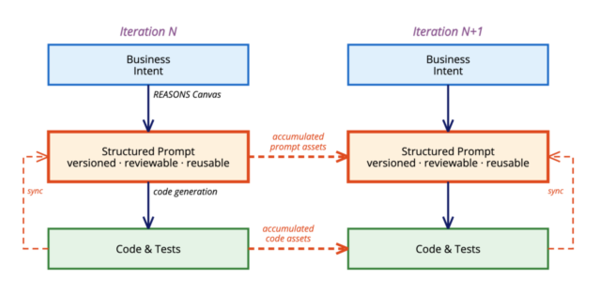
Structured-Prompt-Driven Development (SPDD) is a method developed by Thoughtworks to make AI-assisted software development governable, reviewable, and reusable at the team level. It treats prompts as first-class artifacts stored in version control and uses the REASONS Canvas to structure requirements, design, and constraints. The workflow ensures alignment between business needs and code by closing the loop between intent and implementation through iterative review and synchronization. SPDD aims to scale AI coding benefits across organizations without sacrificing quality or consistency.
- ▪SPDD treats prompts as version-controlled, reusable artifacts that capture requirements, domain models, design decisions, and engineering norms.
- ▪The REASONS Canvas is a seven-part framework used in SPDD to structure prompts with clarity on requirements, entities, approach, system structure, operations, norms, and safeguards.
- ▪The SPDD workflow integrates with development tools via the openspdd CLI and emphasizes syncing changes between code and prompts to prevent drift.
- ▪Developers using SPDD need three core skills: alignment with business goals, abstraction-first thinking, and iterative review practices.
- ▪SPDD enhances spec-driven development by maintaining prompts as living artifacts that evolve with the codebase and support team-wide reuse.
Opening excerpt (first ~120 words) tap to expand
Structured-Prompt-Driven Development (SPDD) How to make LLM-assisted changes governable, reviewable, and reusable LLM programming assistants have demonstrated considerable value, but mostly with individual developers. The internal IT organization in Thoughtworks has been using them for their teams and have developed a method and workflow called Structured Prompt-Driven Development (SPDD). The article describes a simple example of this workflow with details in github. This workflow treats the prompts as a first-class artifact, kept with the code in version control, and used to align development with business needs. We have found that developers need three key skills to be effective: alignment, abstraction-first, and iterative review.
…
Excerpt limited to ~120 words for fair-use compliance. The full article is at martinfowler.com.
Discussion
0 commentsMore from martinfowler.com