Two-Dimensional Material Now Easier to Manufacture
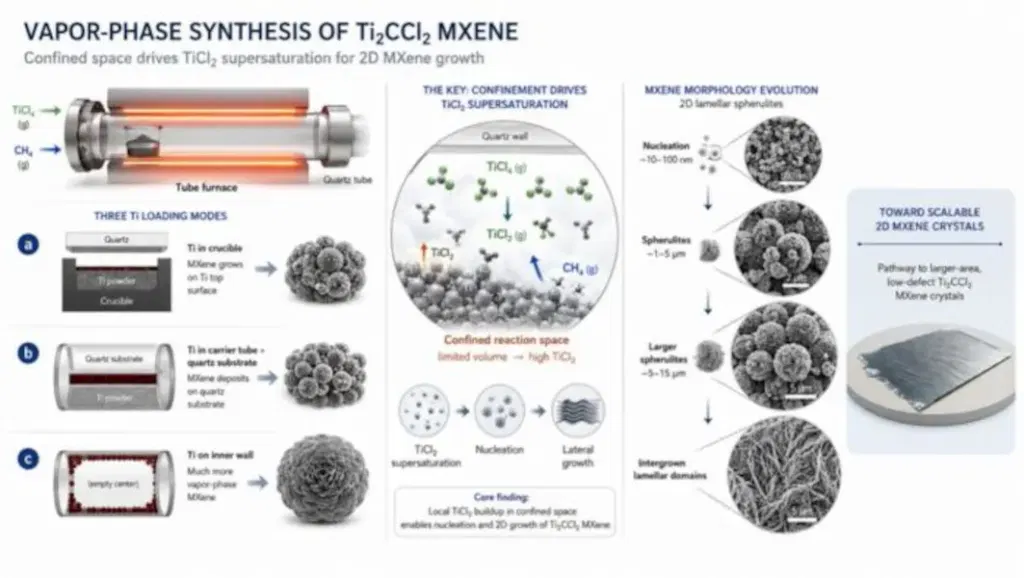
Researchers have developed a more efficient method for manufacturing MXenes, a two-dimensional material previously difficult to produce at scale. The new approach utilizes vapor deposition to simplify the process, reduce costs, and eliminate the need for etching and centrifugation. This advancement enables higher quality and larger quantities of MXenes, supporting their potential use in batteries, antennas, and water purification.
- ▪MXenes are two-dimensional materials that were first produced over a decade ago but were previously difficult to manufacture in industrial quantities.
- ▪The traditional production method involved complex steps including etching and repeated centrifugation to separate byproducts.
- ▪A new vapor deposition process simplifies precursor steps, uses less expensive materials, and skips the etching stage.
- ▪The improved method allows for more controlled growth of MXenes, resulting in higher production amounts and better material quality.
- ▪MXenes have demonstrated potential applications in battery production, antennas, water purification, and switchable Faraday cages.
Hackaday files mainly under tech. We currently carry 480 of its stories.
Story provenance
Source · retrieval · rights · ranking — open for full record
inspect →
Story provenance
Attribution is not the same as permission. This drawer separates discovery metadata, excerpts, WeSearch-generated summaries, reuse status, and whether the publisher receives the visit. Nothing here claims a legal grant the publisher has not made.
Record
| Original publisher | Hackaday |
| Canonical URL | https://hackaday.com/2026/09/28/two-dimensional-material-now-easier-to-manufacture/ |
| Publication time | Tue, 29 Sep 2026 02:00:28 +0000 |
| Retrieval time | 2026-09-29T02:35:59.911Z |
| Last seen | 2026-09-29T02:35:59.911Z |
| Headline source | Publisher (no WeSearch rewrite) |
| Excerpt source | publisher body |
| Excerpt method | First ~120 words (~800 chars) of extracted publisher body, fair-use limited. |
| Summary | WeSearch · cerebras-chat (WeSearch summarizer) |
| Summary source text | contentText |
| Citation coverage | Summary is a WeSearch-generated derivative; primary citation is the original publisher URL. |
| Cluster | DhMekXh7YNEp · 1 stories |
| Cluster logic | Grouped by semantic title/content similarity across sources within a rolling window. Same-publisher template collisions are excluded from coverage comparison. |
| Ranking reason | Story pages are not engagement-ranked. Hub feeds use recency, with optional source-diversified chronological ordering (cap consecutive stories per source). No personalized ranking. |
| Publisher visit | Yes — open original |
| Substitutes article? | No — link-out required for full text |
Rights status (four layers)
WeSearch handling by dimension
| Indexing | May the item be indexed (stored, ranked, made findable)? | Allowed |
| Snippet | May a short excerpt of the publisher's text be shown? | Allowed |
| AI summary | May WeSearch generate its own short summary of the article? | Limited |
| Retrieval / RAG | May the content be exposed for third-party retrieval-augmented generation? | Not asserted |
| Model training | May the content be used to train AI models? | Not asserted |
| Commercial reuse | May the content be reused commercially? | Not permitted |
Basis: Derived from the published RSS/Atom feed. Contact: [email protected]. Reviewed: 2026-07-24.
Opening excerpt (first ~120 words) tap to expand
Two-Dimensional Material Now Easier To Manufacture No comments by: Bryan Cockfield September 28, 2026 Title: Copy Short Link: Copy We often see scientific breakthroughs in journals or other media that’s reported on as if it’s a revolutionary technology guaranteed to reshape human existence, only to never hear about it again. A more cynical reason for this phenomenon is a certain amount of clickbait or engagement farming, but the real culprit often tends to be the discovery of a process that can’t produce the new material or effect at a scale that makes sense for mass production. One of those are MXenes (“max-enes”), a two-dimensional material first produced over a decade ago, but new research into them has developed a much more efficient way of producing them.
…
Excerpt limited to ~120 words for fair-use compliance. The full article is at Hackaday.
Discussion
0 commentsMore from Hackaday