Upgrading a Benchtop Laser for Megawatt Power
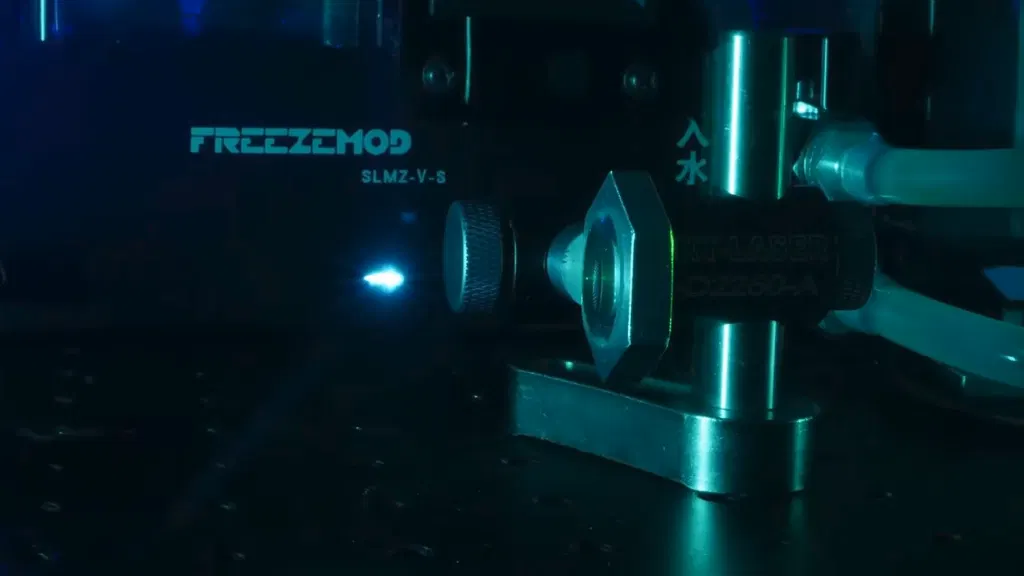
A hobbyist upgraded a benchtop laser by adding a Q-switch to significantly increase its peak power output. The modification reduced the pulse duration from 150 microseconds to 14 nanoseconds, boosting peak power to 1.3 megawatts. Although the higher peak power did not improve metal cutting capabilities, it was sufficient to ionize air and shatter glass.
- ▪A Q-switch is an optical attenuator that limits stimulated emission to allow energy to build up before releasing a short, powerful pulse.
- ▪The addition of a Q-switch reduced the laser pulse length to 14 nanoseconds and increased peak power to 1.3 megawatts.
- ▪Using a Q-switch with 92% absorption resulted in a maximum peak power of 2.25 megawatts.
- ▪The enhanced laser pulses were too short to effectively cut metal but could ionize air and shatter glass.
Hackaday files mainly under tech. We currently carry 531 of its stories.
Story provenance
Source · retrieval · rights · ranking — open for full record
inspect →
Story provenance
Attribution is not the same as permission. This drawer separates discovery metadata, excerpts, WeSearch-generated summaries, reuse status, and whether the publisher receives the visit. Nothing here claims a legal grant the publisher has not made.
Record
| Original publisher | Hackaday |
| Canonical URL | https://hackaday.com/2026/10/04/upgrading-a-benchtop-laser-for-megawatt-power/ |
| Publication time | Mon, 05 Oct 2026 02:00:01 +0000 |
| Retrieval time | 2026-10-05T02:02:14.981Z |
| Last seen | 2026-10-05T02:02:14.981Z |
| Headline source | Publisher (no WeSearch rewrite) |
| Excerpt source | publisher body |
| Excerpt method | First ~120 words (~800 chars) of extracted publisher body, fair-use limited. |
| Summary | WeSearch · cerebras-chat (WeSearch summarizer) |
| Summary source text | contentText |
| Citation coverage | Summary is a WeSearch-generated derivative; primary citation is the original publisher URL. |
| Cluster | D9WhlumS5NGC · 1 stories |
| Cluster logic | Grouped by semantic title/content similarity across sources within a rolling window. Same-publisher template collisions are excluded from coverage comparison. |
| Ranking reason | Story pages are not engagement-ranked. Hub feeds use recency, with optional source-diversified chronological ordering (cap consecutive stories per source). No personalized ranking. |
| Publisher visit | Yes — open original |
| Substitutes article? | No — link-out required for full text |
Rights status (four layers)
WeSearch handling by dimension
| Indexing | May the item be indexed (stored, ranked, made findable)? | Allowed |
| Snippet | May a short excerpt of the publisher's text be shown? | Allowed |
| AI summary | May WeSearch generate its own short summary of the article? | Limited |
| Retrieval / RAG | May the content be exposed for third-party retrieval-augmented generation? | Not asserted |
| Model training | May the content be used to train AI models? | Not asserted |
| Commercial reuse | May the content be reused commercially? | Not permitted |
Basis: Derived from the published RSS/Atom feed. Contact: [email protected]. Reviewed: 2026-07-24.
Opening excerpt (first ~120 words) tap to expand
Upgrading A Benchtop Laser For Megawatt Power No comments by: Aaron Beckendorf October 4, 2026 Title: Copy Short Link: Copy One fascinating thing about a pulsed laser is that, though the average power may be measured in watts or milliwatts, the peak power can easily reach millions of times that. This happens even in normal operation, but as [Les’ Lab] demonstrated, adding a Q-Switch can considerably enhance the peak power. A Q-switch is an optical attenuator; when placed in the laser cavity, it keeps the cavity from reaching resonance. This greatly limits stimulated emission, allowing energy to build up in the chamber as the gain medium becomes increasingly saturated.
…
Excerpt limited to ~120 words for fair-use compliance. The full article is at Hackaday.