AI on Your Gaming PC
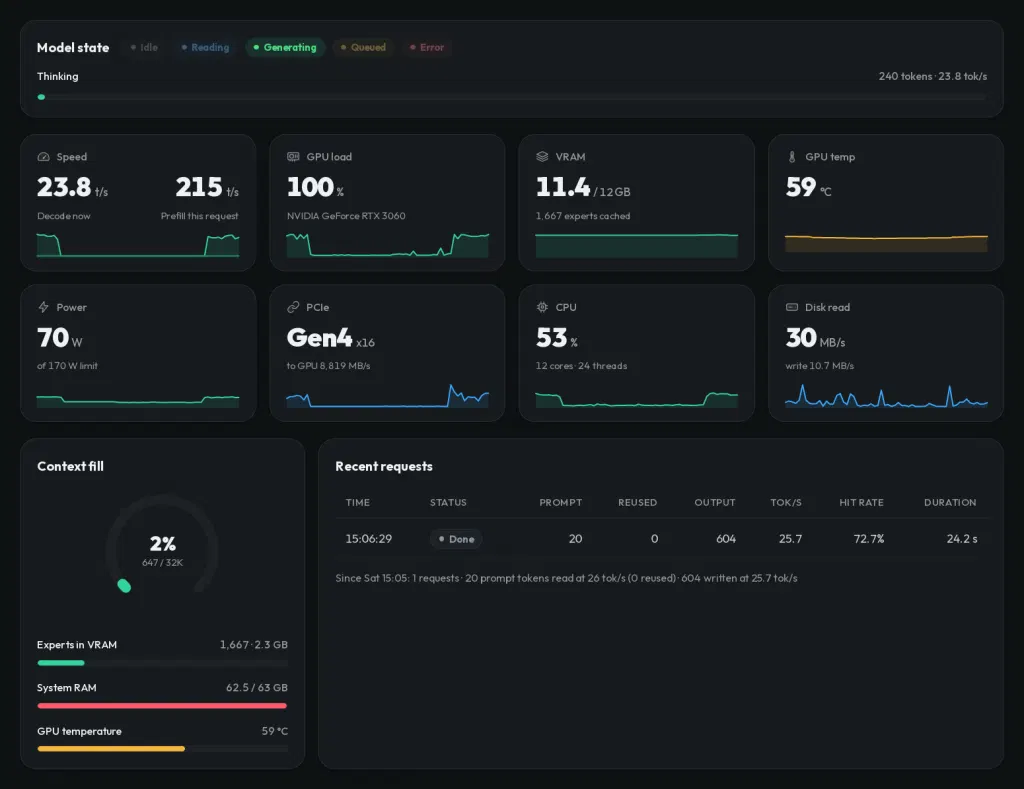
A new project called Strata enables the execution of large language models on standard gaming PC hardware by utilizing clever memory management techniques. It treats VRAM as a cache for a larger model stored in system RAM and SSD, allowing for efficient inference without requiring specialized server-grade equipment. While the setup requires significant resources like 32 GB of RAM and 12 GB of VRAM, it offers a viable local alternative for running complex AI models on consumer devices.
- ▪Strata allows a 125-billion-parameter LLM to run on gaming hardware by using VRAM as a cache for experts stored in system RAM and SSD.
- ▪The project supports Qwen3.8 model variants and utilizes multi-token prediction for speculative decoding to improve speed.
- ▪An RTX 5070 with 12 GB of VRAM can achieve roughly 50 to 90 tokens per second depending on the quantization level.
- ▪Strata exposes OpenAI- and Anthropic-compatible APIs on localhost, enabling integration with existing chat front ends and coding assistants.
- ▪Running the model requires at least 32 GB of system RAM, 12 GB of VRAM, and approximately 80 GB of storage space.
Hackaday files mainly under tech. We currently carry 525 of its stories.
Story provenance
Source · retrieval · rights · ranking — open for full record
inspect →
Story provenance
Attribution is not the same as permission. This drawer separates discovery metadata, excerpts, WeSearch-generated summaries, reuse status, and whether the publisher receives the visit. Nothing here claims a legal grant the publisher has not made.
Record
| Original publisher | Hackaday |
| Canonical URL | https://hackaday.com/2026/10/04/ai-on-your-gaming-pc/ |
| Publication time | Sun, 04 Oct 2026 11:00:40 +0000 |
| Retrieval time | 2026-10-04T11:03:35.155Z |
| Last seen | 2026-10-04T11:03:35.155Z |
| Headline source | Publisher (no WeSearch rewrite) |
| Excerpt source | publisher body |
| Excerpt method | First ~120 words (~800 chars) of extracted publisher body, fair-use limited. |
| Summary | WeSearch · cerebras-chat (WeSearch summarizer) |
| Summary source text | contentText |
| Citation coverage | Summary is a WeSearch-generated derivative; primary citation is the original publisher URL. |
| Cluster | None |
| Cluster logic | Not yet clustered, or no peer story found in the clustering window. |
| Ranking reason | Story pages are not engagement-ranked. Hub feeds use recency, with optional source-diversified chronological ordering (cap consecutive stories per source). No personalized ranking. |
| Publisher visit | Yes — open original |
| Substitutes article? | No — link-out required for full text |
Rights status (four layers)
WeSearch handling by dimension
| Indexing | May the item be indexed (stored, ranked, made findable)? | Allowed |
| Snippet | May a short excerpt of the publisher's text be shown? | Allowed |
| AI summary | May WeSearch generate its own short summary of the article? | Limited |
| Retrieval / RAG | May the content be exposed for third-party retrieval-augmented generation? | Not asserted |
| Model training | May the content be used to train AI models? | Not asserted |
| Commercial reuse | May the content be reused commercially? | Not permitted |
Basis: Derived from the published RSS/Atom feed. Contact: [email protected]. Reviewed: 2026-07-24.
Opening excerpt (first ~120 words) tap to expand
AI On Your Gaming PC No comments by: Al Williams October 4, 2026 Title: Copy Short Link: Copy If you want to experiment with LLMs, you typically have a choice of sending your requests to someone else’s computer or fielding a very large GPU and CPU setup to run models locally. However, a recent crop of projects aims to bring bigger models to much more modest hardware. One example is Strata, a project from [Niko1221], which lets you run a 125-billion-parameter LLM on hardware you might already have for gaming. It won’t run on your old Pentium laptop, but it doesn’t require a supercomputer-like farm of graphics cards, either. Strata can use several Qwen3.8 model variants, including different quantizations of the original model as well as coding and other specialized versions.
…
Excerpt limited to ~120 words for fair-use compliance. The full article is at Hackaday.
Discussion
0 commentsMore from Hackaday