We’ve Never Actually Seen Earth’s Protective Bubble. This New Mission Aims to Change That
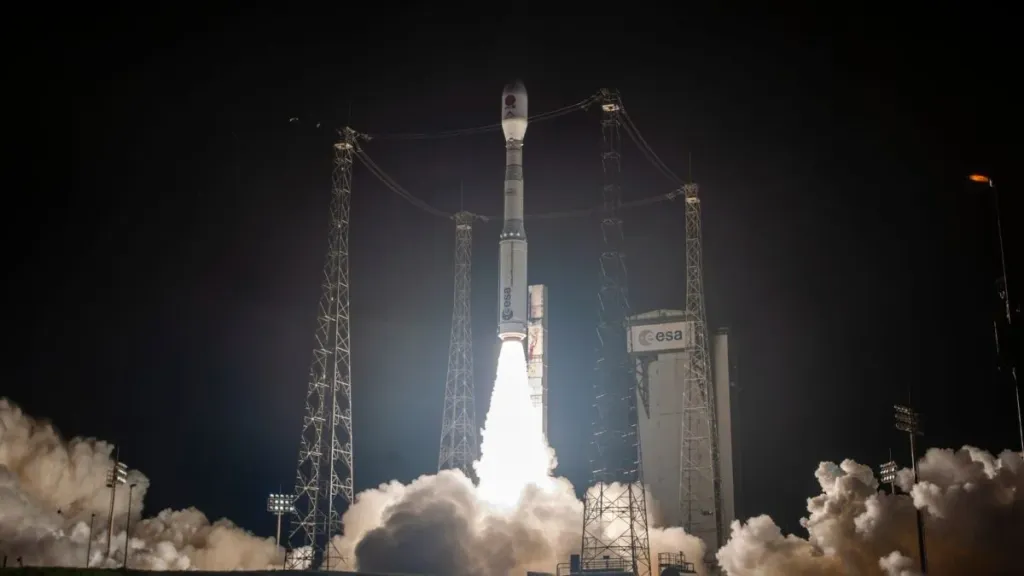
The European Space Agency's Vega-C rocket successfully launched the Solar wind Magnetosphere Link Explorer (SMILE) spacecraft, which aims to enhance our understanding of Earth's magnetosphere. This mission, developed in collaboration with the Chinese Academy of Sciences, will provide unprecedented views of the magnetic bubble that protects Earth from solar radiation. SMILE is expected to begin data collection in July, offering insights into geomagnetic storms and their effects on modern technology.
- ▪The SMILE spacecraft was launched from Kourou, French Guiana, and is designed to capture global images of Earth's magnetosphere.
- ▪This mission will help scientists understand how solar wind interacts with the magnetosphere and causes geomagnetic storms.
- ▪SMILE will operate in a highly elliptical orbit, allowing it to collect continuous observations of the magnetosphere and auroras.
Opening excerpt (first ~120 words) tap to expand
Late Monday evening, the European Space Agency’s Vega-C rocket lifted off from Kourou, French Guiana, carrying a spacecraft that promises to significantly enhance our understanding of space weather. The mission, developed jointly by ESA and the Chinese Academy of Sciences, has been more than a decade in the making.cnx.cmd.push(function(){cnx({"playerId":"92b7b46b-43ed-4e0e-b21b-2c999302d9d7","settings":{"advertising":{"macros":{"AD_UNIT":"/23178111854/od.gizmodo.com/article","CHILD_UNIT":"article","POST_ID":"2000760763","POST_TYPE":"post","CHANNEL":"science","SECTION":"space","SUBSECTION":"","CATEGORIES":"space","TAGS":"esa,geomagnetic-storms,space-weather,spacecraft","NOP":"0"},"timeBeforeFirstAd":0}}}).render("cnx-player-main")}); The Solar wind Magnetosphere Link Explorer, or SMILE for…
Excerpt limited to ~120 words for fair-use compliance. The full article is at Gizmodo.
Discussion
0 commentsMore from Gizmodo