Your Browser Probably Lies to the Big Sites (Blame Chrome)
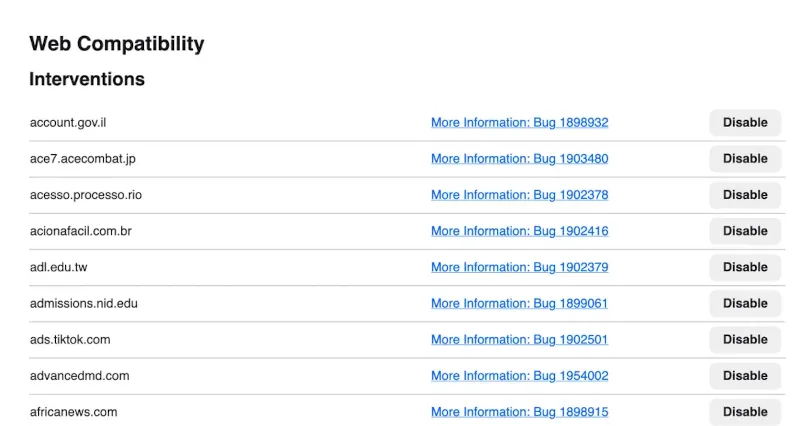
Some browsers like Firefox and Safari alter their behavior when visiting large websites to ensure compatibility, often mimicking Chrome due to its market dominance. This adjustment can include misrepresenting their identity or changing how pages are rendered to prevent display issues. The changes are made to protect user experience rather than stem from collusion between browsers and major sites.
- ▪Chrome's dominance leads websites to optimize for it, sometimes breaking functionality in other browsers.
- ▪Firefox and Safari adapt their behavior to work around sites that don't function correctly outside Chrome.
- ▪Users can view and disable specific compatibility fixes in Firefox by visiting the about:compat URL.
- ▪Safari's compatibility adjustments are documented in a file named quirks, requiring code inspection.
- ▪Bugzilla tracks the compatibility fixes implemented by Firefox for problematic websites.
Hackaday files mainly under tech. We currently carry 211 of its stories.
Story provenance
Source · retrieval · rights · ranking — open for full record
inspect →
Story provenance
Attribution is not the same as permission. This drawer separates discovery metadata, excerpts, WeSearch-generated summaries, reuse status, and whether the publisher receives the visit. Nothing here claims a legal grant the publisher has not made.
Record
| Original publisher | Hackaday |
| Canonical URL | https://hackaday.com/2026/05/16/your-browser-probably-lies-to-the-big-sites-blame-chrome/ |
| Publication time | Sun, 17 May 2026 05:00:40 +0000 |
| Retrieval time | 2026-05-17T05:03:58.483Z |
| Last seen | 2026-05-17T05:03:58.483Z |
| Headline source | Publisher (no WeSearch rewrite) |
| Excerpt source | publisher body |
| Excerpt method | First ~120 words (~800 chars) of extracted publisher body, fair-use limited. |
| Summary | WeSearch · cerebras-chat (WeSearch summarizer) |
| Summary source text | contentText |
| Citation coverage | Summary is a WeSearch-generated derivative; primary citation is the original publisher URL. |
| Cluster | _9vl8z_jqsiM |
| Cluster logic | Grouped by semantic title/content similarity across sources within a rolling window. Same-publisher template collisions are excluded from coverage comparison. |
| Ranking reason | Story pages are not engagement-ranked. Hub feeds use recency, with optional source-diversified chronological ordering (cap consecutive stories per source). No personalized ranking. |
| Publisher visit | Yes — open original |
| Substitutes article? | No — link-out required for full text |
Rights status (four layers)
WeSearch handling by dimension
| Indexing | May the item be indexed (stored, ranked, made findable)? | Allowed |
| Snippet | May a short excerpt of the publisher's text be shown? | Allowed |
| AI summary | May WeSearch generate its own short summary of the article? | Limited |
| Retrieval / RAG | May the content be exposed for third-party retrieval-augmented generation? | Not asserted |
| Model training | May the content be used to train AI models? | Not asserted |
| Commercial reuse | May the content be reused commercially? | Not permitted |
Basis: Derived from the published RSS/Atom feed. Contact: [email protected]. Reviewed: 2026-07-24.
Opening excerpt (first ~120 words) tap to expand
Your Browser Probably Lies To The Big Sites (Blame Chrome) No comments by: Al Williams May 16, 2026 Title: Copy Short Link: Copy When you visit certain large sites in Firefox or Safari, the browser may detect your visit and change its behavior. It could be as simple as lying about its identity, or it may totally change how it renders the page. But according to a post by [Den Odel], this isn’t a conspiracy between browsers and big Internet — rather, it is a byproduct of Chrome’s dominance. Here’s how it goes. Chrome puts out a new feature and everyone rushes to implement it on their site. Maybe the new code breaks other browsers. Maybe the other browser supports the feature, but the website doesn’t detect it correctly or is unaware. Maybe it just relies on some quirk of Chrome.
…
Excerpt limited to ~120 words for fair-use compliance. The full article is at Hackaday.
Discussion
0 commentsMore from Hackaday