Emulating Memory Access: How Hard Can It Be?
The article explores the complexities of emulating x86 memory access on ARM architectures, highlighting that simple data storage models fail to account for cache and multi-CPU interactions. It details how differences in memory ordering models, such as x86's Total Store Ordering versus ARM's weaker model, create significant performance challenges for emulators like FEX-Emu. Specific issues including unaligned accesses, atomic operations, and write-combined GPU memory can cause severe slowdowns, though newer hardware extensions and kernel optimizations are helping to mitigate these architectural discrepancies.
- ▪x86 uses a Total Store Ordering model that provides strong visibility guarantees, whereas ARM uses a weaker memory model that allows more reordering for efficiency.
- ▪Emulating x86 atomic operations on ARM can be extremely slow, with some split-lock operations requiring kernel excursions that are hundreds or thousands of times slower than normal cases.
- ▪Write-combined GPU memory presents a major challenge for ARM emulators, with FEX measuring worst-case bandwidth reductions of over 800 times compared to native x86 performance.
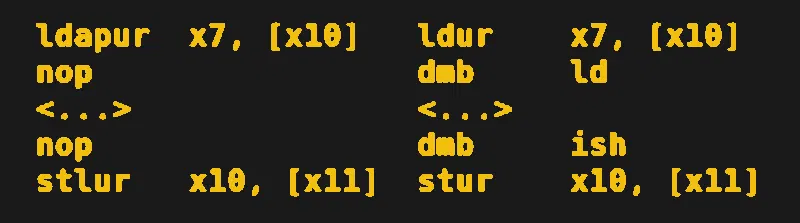
- ▪Apple Silicon addresses some of these issues by adding an x86-compatible TSO mode, while Qualcomm's Oryon cores support coherent cache-line atomics to improve emulation fidelity.
Hackaday files mainly under tech. We currently carry 394 of its stories.
Story provenance
Source · retrieval · rights · ranking — open for full record
inspect →
Story provenance
Attribution is not the same as permission. This drawer separates discovery metadata, excerpts, WeSearch-generated summaries, reuse status, and whether the publisher receives the visit. Nothing here claims a legal grant the publisher has not made.
Record
| Original publisher | Hackaday |
| Canonical URL | https://hackaday.com/2026/09/19/emulating-memory-access-how-hard-can-it-be/ |
| Publication time | Sat, 19 Sep 2026 08:00:10 +0000 |
| Retrieval time | 2026-09-19T08:03:47.070Z |
| Last seen | 2026-09-19T08:03:47.070Z |
| Headline source | Publisher (no WeSearch rewrite) |
| Excerpt source | publisher body |
| Excerpt method | First ~120 words (~800 chars) of extracted publisher body, fair-use limited. |
| Summary | WeSearch · cerebras-chat (WeSearch summarizer) |
| Summary source text | contentText |
| Citation coverage | Summary is a WeSearch-generated derivative; primary citation is the original publisher URL. |
| Cluster | MzQyi3-x20vd · 1 stories |
| Cluster logic | Grouped by semantic title/content similarity across sources within a rolling window. Same-publisher template collisions are excluded from coverage comparison. |
| Ranking reason | Story pages are not engagement-ranked. Hub feeds use recency, with optional source-diversified chronological ordering (cap consecutive stories per source). No personalized ranking. |
| Publisher visit | Yes — open original |
| Substitutes article? | No — link-out required for full text |
Rights status (four layers)
WeSearch handling by dimension
| Indexing | May the item be indexed (stored, ranked, made findable)? | Allowed |
| Snippet | May a short excerpt of the publisher's text be shown? | Allowed |
| AI summary | May WeSearch generate its own short summary of the article? | Limited |
| Retrieval / RAG | May the content be exposed for third-party retrieval-augmented generation? | Not asserted |
| Model training | May the content be used to train AI models? | Not asserted |
| Commercial reuse | May the content be reused commercially? | Not permitted |
Basis: Derived from the published RSS/Atom feed. Contact: [email protected]. Reviewed: 2026-07-24.
Opening excerpt (first ~120 words) tap to expand
Emulating Memory Access: How Hard Can It Be? No comments by: Al Williams September 19, 2026 Title: Copy Short Link: Copy There are so many things we approximate to make life simple. Wires, for example, have no resistance or other strange effects. Crystal oscillators output their exact frequency. But surely our model of how a computer stores and loads memory is accurate, right? You put data in a particular location and, later, you take it out. The [FEX-Emu] developers have a different perspective. Once you have caches and, perhaps, multiple CPUs, it isn’t that easy.
…
Excerpt limited to ~120 words for fair-use compliance. The full article is at Hackaday.
Discussion
0 commentsMore from Hackaday