Reconstructing a Pin on a Pin Grid Array Package
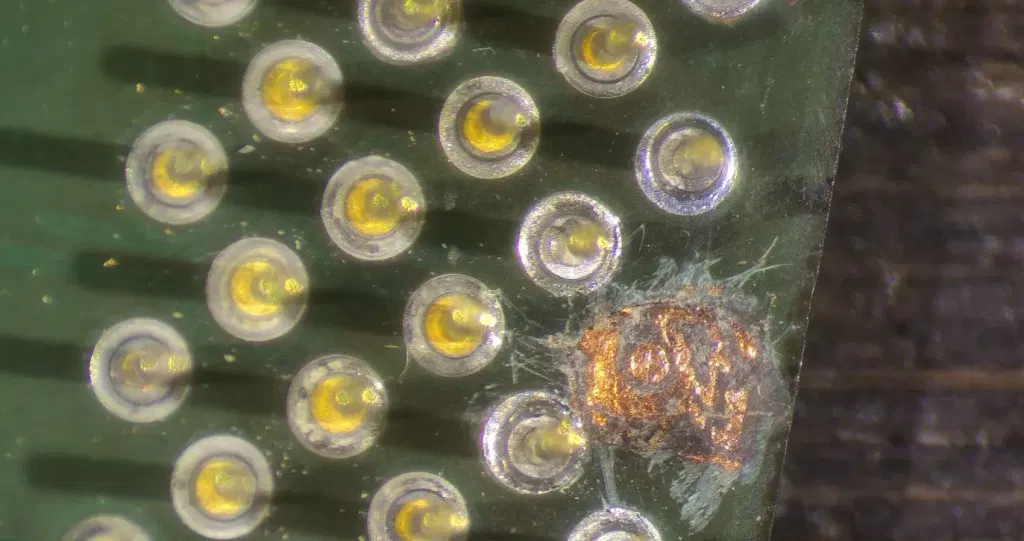
The article details the repair of a Pentium III processor that suffered damage to a critical pin grid array pad. The technician reconstructed the destroyed pad using solder mask and solder to restore functionality. The repaired CPU was successfully tested and overclocked to 1.6 GHz, outperforming contemporary processors.
- ▪Pin grid array packaging involves soldering pins onto the processor substrate rather than the motherboard.
- ▪The specific repair involved rebuilding a destroyed data pad on a 1.2 GHz Tualatin Pentium III core.
- ▪Solder mask and solder were utilized to reconstruct the damaged pad on the CPU substrate.
- ▪The repaired processor was overclocked to 1.6 GHz and demonstrated performance superior to Pentium 4 and AMD Athlon CPUs of the same era.
Hackaday files mainly under tech. We currently carry 389 of its stories.
Story provenance
Source · retrieval · rights · ranking — open for full record
inspect →
Story provenance
Attribution is not the same as permission. This drawer separates discovery metadata, excerpts, WeSearch-generated summaries, reuse status, and whether the publisher receives the visit. Nothing here claims a legal grant the publisher has not made.
Record
| Original publisher | Hackaday |
| Canonical URL | https://hackaday.com/2026/09/18/reconstructing-a-pin-on-a-pin-grid-array-package/ |
| Publication time | Fri, 18 Sep 2026 18:30:22 +0000 |
| Retrieval time | 2026-09-18T18:33:45.417Z |
| Last seen | 2026-09-18T18:33:45.417Z |
| Headline source | Publisher (no WeSearch rewrite) |
| Excerpt source | publisher body |
| Excerpt method | First ~120 words (~800 chars) of extracted publisher body, fair-use limited. |
| Summary | WeSearch · cerebras-chat (WeSearch summarizer) |
| Summary source text | contentText |
| Citation coverage | Summary is a WeSearch-generated derivative; primary citation is the original publisher URL. |
| Cluster | HuCrM0qeRTQD · 1 stories |
| Cluster logic | Grouped by semantic title/content similarity across sources within a rolling window. Same-publisher template collisions are excluded from coverage comparison. |
| Ranking reason | Story pages are not engagement-ranked. Hub feeds use recency, with optional source-diversified chronological ordering (cap consecutive stories per source). No personalized ranking. |
| Publisher visit | Yes — open original |
| Substitutes article? | No — link-out required for full text |
Rights status (four layers)
WeSearch handling by dimension
| Indexing | May the item be indexed (stored, ranked, made findable)? | Allowed |
| Snippet | May a short excerpt of the publisher's text be shown? | Allowed |
| AI summary | May WeSearch generate its own short summary of the article? | Limited |
| Retrieval / RAG | May the content be exposed for third-party retrieval-augmented generation? | Not asserted |
| Model training | May the content be used to train AI models? | Not asserted |
| Commercial reuse | May the content be reused commercially? | Not permitted |
Basis: Derived from the published RSS/Atom feed. Contact: [email protected]. Reviewed: 2026-07-24.
Opening excerpt (first ~120 words) tap to expand
Reconstructing A Pin On A Pin Grid Array Package No comments by: Maya Posch September 18, 2026 Title: Copy Short Link: Copy Before moving to land grid array (LGA) packaging whereby each pin on the substrate is just a copper pad, processors commonly used pin grid array (PGA) packaging, including the still highly relevant AMD AM4 socket. With PGA you get a pin soldered onto the copper pad which inserts into the ZIF socket, rather than a fragile pin on the mainboard side. Repairing a damaged PGA pin can be easy if just the pin broke off at the solder joint, or rough if the pad was destroyed, as in the case of this Pentium III CPU that [Bits und Bolts] recently tried to fix.
…
Excerpt limited to ~120 words for fair-use compliance. The full article is at Hackaday.
Discussion
0 commentsMore from Hackaday