Sony’s First Computer
Sony released the SMC-70 in 1982 as a distinctive desktop computer that featured a unique module stacking system instead of traditional expansion boards. While its core hardware was standard for the era, it offered advanced 16-color graphics and sound capabilities that set it apart from competitors. The machine included innovative features like a dedicated help button and a RAM disk mode, though it ultimately did not become a market leader.
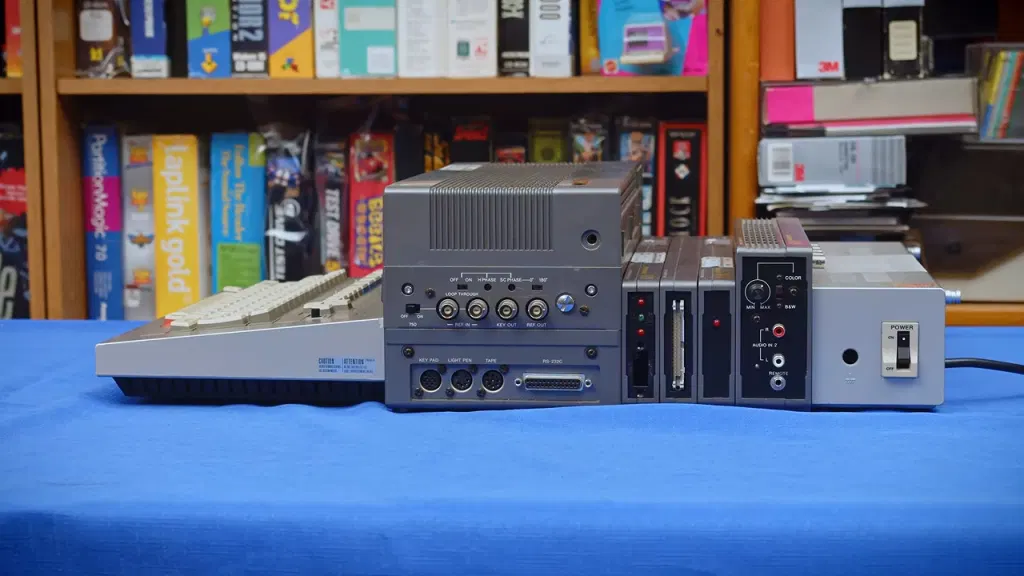
- ▪The SMC-70 used a mechanical skewer system to secure stacked modules rather than the standard plug-in boards found in other computers of the time.
- ▪The computer ran on CP/M with a 4 MHz Z-80 processor and included 3.5-inch floppy drives, which were uncommon for CP/M systems in 1982.
- ▪It featured a 16-color graphics system and sound capabilities that were considered ahead of its time for 1982.
- ▪An 8086 module was eventually released for the SMC-70 but arrived late and only supported CP/M-86, not MS-DOS.
Hackaday files mainly under tech. We currently carry 391 of its stories.
Story provenance
Source · retrieval · rights · ranking — open for full record
inspect →
Story provenance
Attribution is not the same as permission. This drawer separates discovery metadata, excerpts, WeSearch-generated summaries, reuse status, and whether the publisher receives the visit. Nothing here claims a legal grant the publisher has not made.
Record
| Original publisher | Hackaday |
| Canonical URL | https://hackaday.com/2026/09/18/sonys-first-computer/ |
| Publication time | Fri, 18 Sep 2026 23:00:59 +0000 |
| Retrieval time | 2026-09-18T23:03:46.235Z |
| Last seen | 2026-09-18T23:03:46.235Z |
| Headline source | Publisher (no WeSearch rewrite) |
| Excerpt source | publisher body |
| Excerpt method | First ~120 words (~800 chars) of extracted publisher body, fair-use limited. |
| Summary | WeSearch · cerebras-chat (WeSearch summarizer) |
| Summary source text | contentText |
| Citation coverage | Summary is a WeSearch-generated derivative; primary citation is the original publisher URL. |
| Cluster | None |
| Cluster logic | Not yet clustered, or no peer story found in the clustering window. |
| Ranking reason | Story pages are not engagement-ranked. Hub feeds use recency, with optional source-diversified chronological ordering (cap consecutive stories per source). No personalized ranking. |
| Publisher visit | Yes — open original |
| Substitutes article? | No — link-out required for full text |
Rights status (four layers)
WeSearch handling by dimension
| Indexing | May the item be indexed (stored, ranked, made findable)? | Allowed |
| Snippet | May a short excerpt of the publisher's text be shown? | Allowed |
| AI summary | May WeSearch generate its own short summary of the article? | Limited |
| Retrieval / RAG | May the content be exposed for third-party retrieval-augmented generation? | Not asserted |
| Model training | May the content be used to train AI models? | Not asserted |
| Commercial reuse | May the content be reused commercially? | Not permitted |
Basis: Derived from the published RSS/Atom feed. Contact: [email protected]. Reviewed: 2026-07-24.
Opening excerpt (first ~120 words) tap to expand
Sony’s First Computer No comments by: Al Williams September 18, 2026 Title: Copy Short Link: Copy In 1982, desktop computers were coming into their own, and no clear leaders had emerged. But everyone knew they wanted a piece of the action. This led to, among other things, Sony’s SMC-70, which, frankly, for 1982, was a good-looking, if not oddball, machine. [Tech Tangents] shows the machine off in a recent video. From the front, the computer looks more-or-less like everything else. But as you move backward, you can see this computer wasn’t another typical entry into the market. One of the things that was the hallmark of successful business computers of the day was expandability. The earlier Altair had the later-titled S100 bus. The IBM PC had the ISA bus.
…
Excerpt limited to ~120 words for fair-use compliance. The full article is at Hackaday.
Discussion
0 commentsMore from Hackaday