Going on a Tangent with the Intel 8087’s Hybrid CORDIC Algorithm
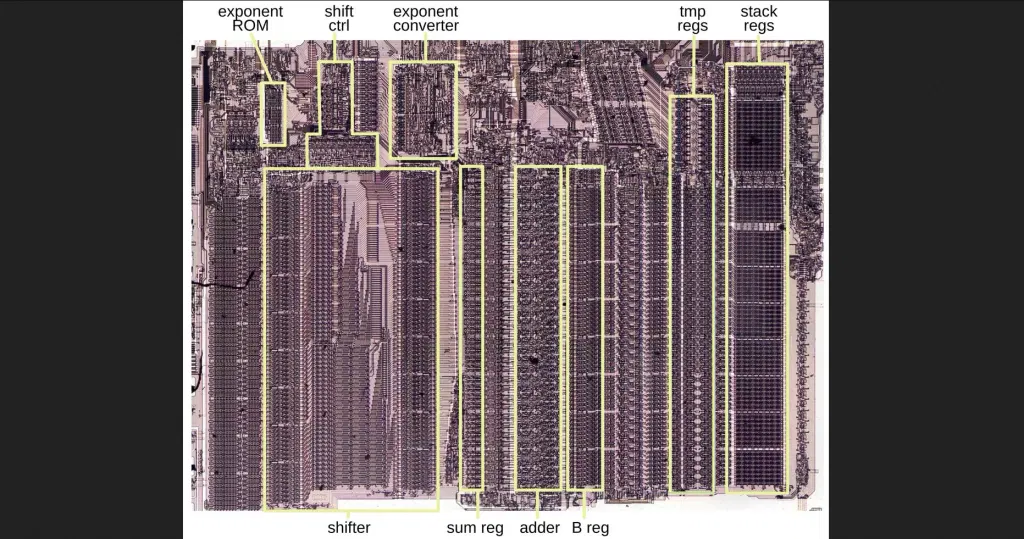
Ken Shirriff and colleagues reverse-engineered the Intel 8087 FPU to analyze its hybrid CORDIC algorithm for trigonometric functions. The implementation combines CORDIC iterations with Padé approximants to achieve 64-bit accuracy efficiently. This approach allowed the 8087 to balance speed and precision without requiring large lookup tables or excessive computation time.
- ▪The Intel 8087 FPU uses a hybrid algorithm that calculates the first 16 bits of trigonometric results using CORDIC.
- ▪The remaining bits are computed using Padé approximants, which are fast and accurate for small residual values.
- ▪Analysis shows that FPTAN operations spend approximately 33% of time on CORDIC pseudo-division and 47% on pseudo-multiplication.
- ▪Intel later abandoned CORDIC in the Pentium series due to scaling difficulties for high-precision calculations.
- ▪The full microcode listing for the 8087's trigonometric functions has been documented with comments by Ken Shirriff.
Hackaday files mainly under tech. We currently carry 469 of its stories.
Story provenance
Source · retrieval · rights · ranking — open for full record
inspect →
Story provenance
Attribution is not the same as permission. This drawer separates discovery metadata, excerpts, WeSearch-generated summaries, reuse status, and whether the publisher receives the visit. Nothing here claims a legal grant the publisher has not made.
Record
| Original publisher | Hackaday |
| Canonical URL | https://hackaday.com/2026/09/27/going-on-a-tangent-with-the-intel-8087s-hybrid-cordic-algorithm/ |
| Publication time | Sun, 27 Sep 2026 23:00:00 +0000 |
| Retrieval time | 2026-09-27T23:01:06.531Z |
| Last seen | 2026-09-27T23:01:06.531Z |
| Headline source | Publisher (no WeSearch rewrite) |
| Excerpt source | publisher body |
| Excerpt method | First ~120 words (~800 chars) of extracted publisher body, fair-use limited. |
| Summary | WeSearch · cerebras-chat (WeSearch summarizer) |
| Summary source text | contentText |
| Citation coverage | Summary is a WeSearch-generated derivative; primary citation is the original publisher URL. |
| Cluster | ijZxmLcU0zN- · 1 stories |
| Cluster logic | Grouped by semantic title/content similarity across sources within a rolling window. Same-publisher template collisions are excluded from coverage comparison. |
| Ranking reason | Story pages are not engagement-ranked. Hub feeds use recency, with optional source-diversified chronological ordering (cap consecutive stories per source). No personalized ranking. |
| Publisher visit | Yes — open original |
| Substitutes article? | No — link-out required for full text |
Rights status (four layers)
WeSearch handling by dimension
| Indexing | May the item be indexed (stored, ranked, made findable)? | Allowed |
| Snippet | May a short excerpt of the publisher's text be shown? | Allowed |
| AI summary | May WeSearch generate its own short summary of the article? | Limited |
| Retrieval / RAG | May the content be exposed for third-party retrieval-augmented generation? | Not asserted |
| Model training | May the content be used to train AI models? | Not asserted |
| Commercial reuse | May the content be reused commercially? | Not permitted |
Basis: Derived from the published RSS/Atom feed. Contact: [email protected]. Reviewed: 2026-07-24.
Opening excerpt (first ~120 words) tap to expand
Going On A Tangent With The Intel 8087’s Hybrid CORDIC Algorithm No comments by: Maya Posch September 27, 2026 Title: Copy Short Link: Copy Continuing their reverse-engineering of Intel’s 8087 FPU, [Ken Shirriff] and friends took a look at one of the trigonometric functions, specifically FPTAN. The most exciting part with such reverse-engineering is probably figuring out which algorithm was used in the implementation, while trying to determine the reasoning behind the final hardware design. If you’re running a simple MCU or MPU like the 6502 or Z80 without hardware functions you’d likely use an algorithm such as CORDIC or similar, as this requires only basic hardware features like addition, subtraction, bitshift, and look-up tables.
…
Excerpt limited to ~120 words for fair-use compliance. The full article is at Hackaday.
Discussion
0 commentsMore from Hackaday