How a free flow of information can amplify incorrect ideas
A study from the University of Groningen highlights how unrestricted information flow can amplify incorrect beliefs among like-minded individuals. The research indicates that even with honest and accurate information exchange, group beliefs can become less accurate. This phenomenon raises concerns about the implications for social media and the need for better-designed communication platforms.
- ▪The study published in the Proceedings of the National Academy of Sciences shows that unrestricted information exchange can reduce the accuracy of group beliefs.
- ▪Agents in the study tended to interact with like-minded individuals, leading to polarization of beliefs.
- ▪The findings suggest that even in ideal conditions, the effects of information sharing can be detrimental, indicating a need for more rigorous scientific methods in understanding social media's impact.
Opening excerpt (first ~120 words) tap to expand
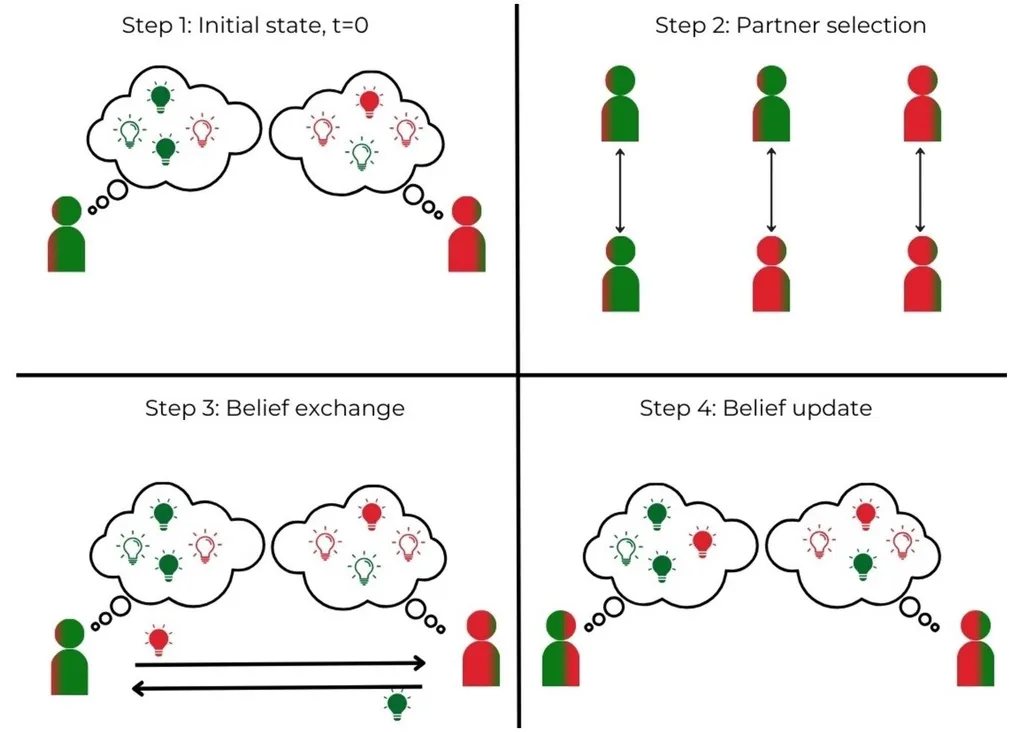
April 28, 2026 How a free flow of information can amplify incorrect ideas by University of Groningen edited by Robert Egan Robert Egan Associate Editor Meet our editorial team Behind our editorial process Editors' notes This article has been reviewed according to Science X's editorial process and policies. Editors have highlighted the following attributes while ensuring the content's credibility: fact-checked peer-reviewed publication trusted source proofread The GIST Add as preferred source Agents have partial observations (lightbulbs) about the state of the world: green or red. Their observations determine their initial beliefs: green-leaning or red-leaning. Agents are randomly paired, and the likelihood of being paired increases with belief similarity.
…
Excerpt limited to ~120 words for fair-use compliance. The full article is at Phys.org.
Discussion
0 commentsMore from Phys.org