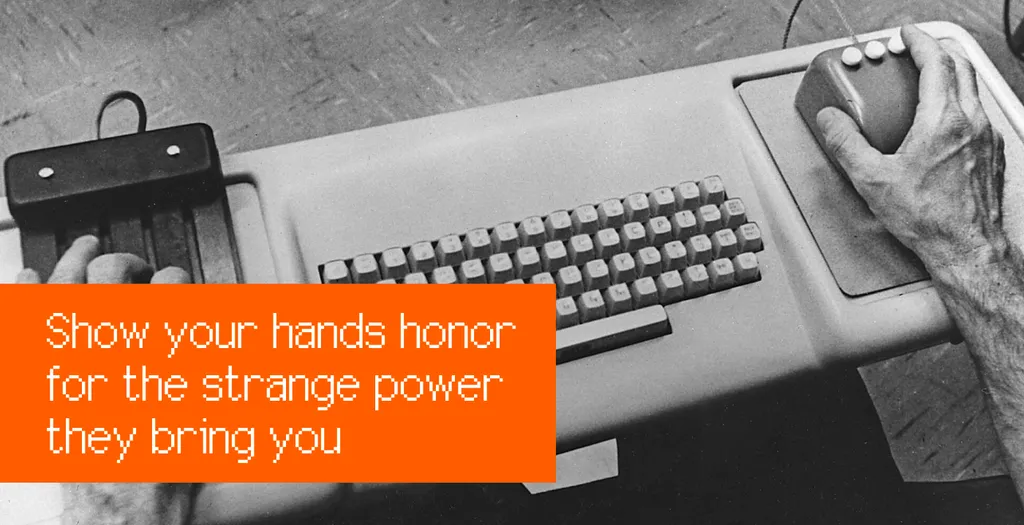
Show your hands honor for the power they bring you
The article discusses the capabilities of human hands and fingers, particularly in relation to typing and interacting with technology. It highlights the history of typewriters and the development of keyboard interactions, including the concept of overlapping and the importance of respecting finger independence. The article also touches on the role of designers in creating interfaces that accommodate the unique abilities of human hands and fingers.
- ▪People were able to type faster than what was thought to be physically possible, with some reaching speeds of 70 words per minute or more.
- ▪The QWERTY layout was designed to allow for fast typing, and fingers are capable of moving independently, allowing for overlapping and efficient typing.
- ▪The development of computer interfaces has not always respected the capabilities of human hands and fingers, with early terminals and keyboards often creating unpleasant typing experiences due to delays and limitations.
Hacker News (Front Page) files mainly under programming. We currently carry 1,455 of its stories. Top-voted stories on Hacker News.
Story provenance
Source · retrieval · rights · ranking — open for full record
inspect →
Story provenance
Attribution is not the same as permission. This drawer separates discovery metadata, excerpts, WeSearch-generated summaries, reuse status, and whether the publisher receives the visit. Nothing here claims a legal grant the publisher has not made.
Record
| Original publisher | Aresluna |
| Canonical URL | https://aresluna.org/show-your-hands-honor/ |
| Publication time | Sun, 05 Jul 2026 04:10:09 +0000 |
| Retrieval time | 2026-07-05T05:25:14.402Z |
| Last seen | 2026-07-05T05:25:14.402Z |
| Headline source | Publisher (no WeSearch rewrite) |
| Excerpt source | publisher body |
| Excerpt method | First ~120 words (~800 chars) of extracted publisher body, fair-use limited. |
| Summary | WeSearch · cerebras-chat (WeSearch summarizer) |
| Summary source text | contentText |
| Citation coverage | Summary is a WeSearch-generated derivative; primary citation is the original publisher URL. |
| Cluster | 5tLVfkDePzaX |
| Cluster logic | Grouped by semantic title/content similarity across sources within a rolling window. Same-publisher template collisions are excluded from coverage comparison. |
| Ranking reason | Story pages are not engagement-ranked. Hub feeds use recency, with optional source-diversified chronological ordering (cap consecutive stories per source). No personalized ranking. |
| Publisher visit | Yes — open original |
| Substitutes article? | No — link-out required for full text |
Rights status (four layers)
WeSearch handling by dimension
| Indexing | May the item be indexed (stored, ranked, made findable)? | Allowed |
| Snippet | May a short excerpt of the publisher's text be shown? | Allowed |
| AI summary | May WeSearch generate its own short summary of the article? | Limited |
| Retrieval / RAG | May the content be exposed for third-party retrieval-augmented generation? | Not asserted |
| Model training | May the content be used to train AI models? | Not asserted |
| Commercial reuse | May the content be reused commercially? | Not permitted |
Basis: Derived from the published RSS/Atom feed. Contact: [email protected]. Reviewed: 2026-07-24.
Opening excerpt (first ~120 words) tap to expand
Marcin Wichary 18 June 2026 / 7,700 words / 38 playgrounds Show your hands honor for the strange power they bring you On designing finger-friendly interactions A hundred or so years ago, there was a problem. People were simply typing too fast. I know what you’re thinking: they were typing too fast for the primitive typewriters of that era. But contrary to popular belief, typewriters were never that primitive. You could type really fast on even the first popular typewriter, and the QWERTY layout was actually designed to allow you to do just that. No, people were typing too fast for what we thought our bodies were capable of.
…
Excerpt limited to ~120 words for fair-use compliance. The full article is at Aresluna.
Discussion
0 commentsMore from Aresluna