Is It the Shoes?
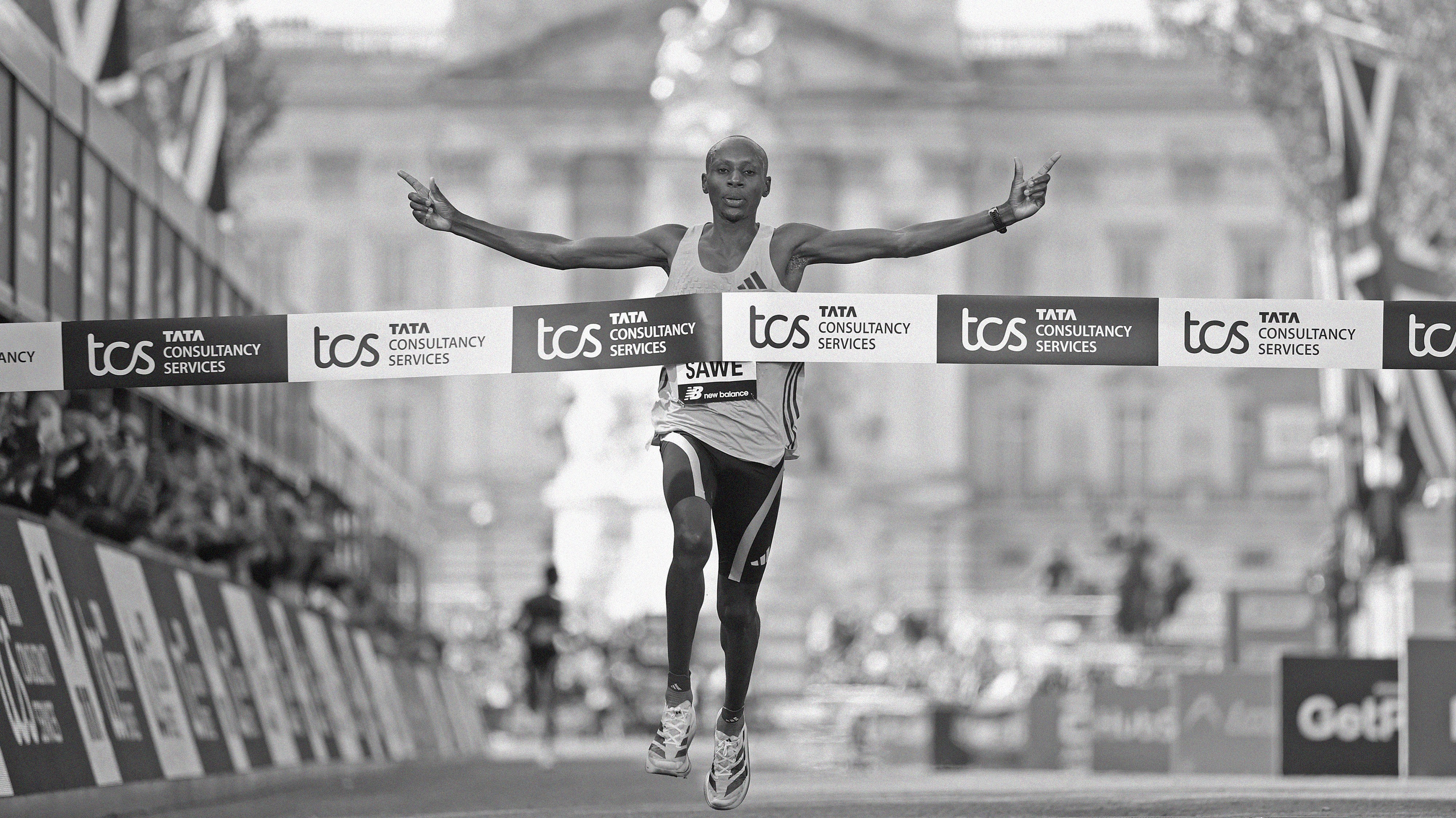
Kenyan runner Sabastian Sawe broke the two-hour marathon barrier at the 2026 London Marathon, finishing in 1:59:30, with Ethiopia's Yomif Kejelcha also under two hours in second place. The achievement follows years of technological advances, particularly in supershoes, and meticulous preparation including extensive anti-doping testing. While the milestone was long considered impossible, innovations in footwear, pacing, and training have accelerated progress in elite marathoning. The performance comes amid ongoing debates about technology's role in record-breaking and the integrity of the sport.
Full article excerpt tap to expand
HealthThe Marathon That Bent RealityHow does a human run 26.2 miles in less than two hours?By Alex HutchinsonAlex Davidson / GettyApril 27, 2026, 8:36 PM ET ShareSave To understand the significance of someone running a marathon in less than two hours, you also need to understand that, until recently, the notion of this actually happening was truly, utterly absurd. Sure, a physiologist named Michael Joyner had floated the idea that such a feat might be humanly possible in a journal paper way back in 1991. But his peers laughed off the idea, and not much changed over the succeeding decades. In Runner’s World in 2014, I predicted that it would happen in 2075. Frankly, even that forecast seemed overly optimistic to me, but I figured I’d be dead by then, so no one would be able to call me on it.Well, I was wrong. Yesterday morning, the two-hour marathon barrier finally went down. A relatively unheralded 31-year-old Kenyan named Sabastian Sawe won the London Marathon with a time of 1:59:30. That is, for reference, 26.2 miles run at an average of 4:34 a mile—or, put another way, a pace that most recreational runners would struggle to sustain for more than a few seconds, if they could hit it at all. Perhaps even more arresting was the fact that the man who took second place, Ethiopia’s Yomif Kejelcha, also ran under two hours, finishing just 11 seconds behind Sawe.The feat was the culmination of a shift—or, perhaps more aptly, a total disruption—in marathoning over the past few years, in which the eventual breaking of the mythical two-hour mark went from an impossibility to a guarantee. When sports are young, they progress by leaps and bounds. The first marathon over the now-standard distance of 26 miles, 385 yards, contested at the 1908 London Olympics, was won in 2:55:19. Progress in the succeeding decades was rapid, but by 1991 the sport was mature, professionalized, and lucrative. When Joyner made his prediction, the world record had advanced by less than two minutes since the 1960s. Logic dictated that future decades would see even slower progress, as runners approached insurmountable limits in factors such as how much training they could handle and how much fuel their muscles could store.The turning point came in 2016, when Nike announced its Breaking2 project. The famous Kenyan runner Eliud Kipchoge and two others were chosen as the centerpieces of a multimillion-dollar attempt to engineer every detail of a sub-two-hour marathon: nutrition, hydration, training, shoes, weather, drafting, pacing, and so on. On a Formula 1 track in Monza, Italy, in May 2017, Kipchoge ended up running 2:00:25, astonishingly and unexpectedly close to the barrier. He ran virtually the entire race behind an arrowhead formation of six pacers who blocked the wind for him; the pacers swapped in and out throughout the race, intentionally violating the rule that all competitors must start at the same time, which meant it didn’t count as a world record. But at that moment, the conversation shifted from when to if.What remained unclear after Breaking2 was how Kipchoge had run so fast. Was he simply a generational talent? Was it the drafting, which aerodynamics experts argued could shave several minutes off his time all by itself? Or was it the shoes? Nike had unveiled a radically new design for Breaking2, incorporating a curved carbon-fiber plate into a thick wedge of springy midsole foam, which external lab data suggested would make runners several percent faster.…
This excerpt is published under fair use for community discussion. Read the full article at The Atlantic.
Discussion
0 commentsMore from The Atlantic