The Sinclair Spectrum Gets A Desktop GUI
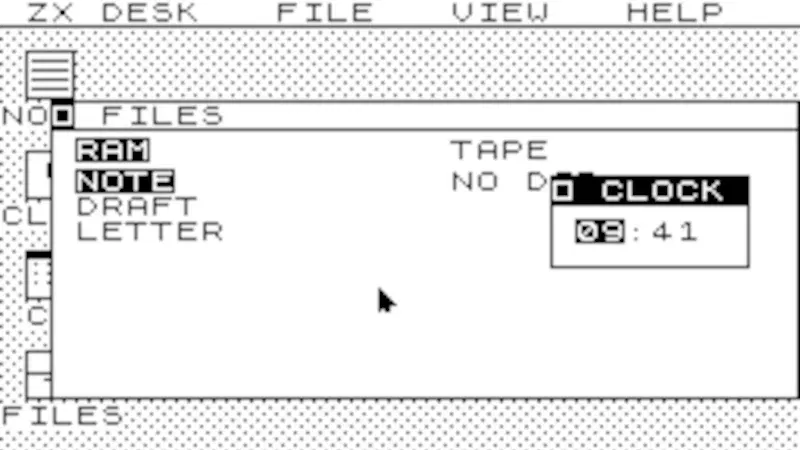
A developer has created ZXdesk, an assembly language program that implements a desktop GUI on the 48k Sinclair ZX Spectrum. The interface features menus, windows, and applications, resembling the GEM operating system from the 1980s. Although it lacks a disk drive and thus does not function as a traditional standalone operating system, it represents a significant technical achievement for the classic 8-bit machine.
- ▪ZXdesk is an assembly language program designed specifically for the 48k Sinclair ZX Spectrum.
- ▪The GUI includes standard desktop elements such as menus, windows, and integrated applications.
- ▪The 48k Spectrum model lacks a disk drive, meaning applications are built into the GUI rather than running independently from storage.
- ▪The project is considered the closest approximation to a full operating system ever seen on this specific home computer model.
Hackaday files mainly under tech. We currently carry 410 of its stories.
Story provenance
Source · retrieval · rights · ranking — open for full record
inspect →
Story provenance
Attribution is not the same as permission. This drawer separates discovery metadata, excerpts, WeSearch-generated summaries, reuse status, and whether the publisher receives the visit. Nothing here claims a legal grant the publisher has not made.
Record
| Original publisher | Hackaday |
| Canonical URL | https://hackaday.com/2026/09/21/the-sinclair-spectrum-gets-a-desktop-gui/ |
| Publication time | Mon, 21 Sep 2026 08:00:34 +0000 |
| Retrieval time | 2026-09-21T08:03:48.871Z |
| Last seen | 2026-09-21T08:03:48.871Z |
| Headline source | Publisher (no WeSearch rewrite) |
| Excerpt source | publisher body |
| Excerpt method | First ~120 words (~800 chars) of extracted publisher body, fair-use limited. |
| Summary | WeSearch · cerebras-chat (WeSearch summarizer) |
| Summary source text | contentText |
| Citation coverage | Summary is a WeSearch-generated derivative; primary citation is the original publisher URL. |
| Cluster | MmCus01MKsFC · 1 stories |
| Cluster logic | Grouped by semantic title/content similarity across sources within a rolling window. Same-publisher template collisions are excluded from coverage comparison. |
| Ranking reason | Story pages are not engagement-ranked. Hub feeds use recency, with optional source-diversified chronological ordering (cap consecutive stories per source). No personalized ranking. |
| Publisher visit | Yes — open original |
| Substitutes article? | No — link-out required for full text |
Rights status (four layers)
WeSearch handling by dimension
| Indexing | May the item be indexed (stored, ranked, made findable)? | Allowed |
| Snippet | May a short excerpt of the publisher's text be shown? | Allowed |
| AI summary | May WeSearch generate its own short summary of the article? | Limited |
| Retrieval / RAG | May the content be exposed for third-party retrieval-augmented generation? | Not asserted |
| Model training | May the content be used to train AI models? | Not asserted |
| Commercial reuse | May the content be reused commercially? | Not permitted |
Basis: Derived from the published RSS/Atom feed. Contact: [email protected]. Reviewed: 2026-07-24.
Opening excerpt (first ~120 words) tap to expand
The Sinclair Spectrum Gets A Desktop GUI No comments by: Jenny List September 21, 2026 Title: Copy Short Link: Copy Of the popular 1980s 8-bit computers, it’s fair to say that Sinclair’s ZX Spectrum punched above its weight. Sir Clive’s love of squeezing more functionality out of less hardware meant the compromises he made left it less powerful than competitors from Apple, Commodore, or Acorn. Still, the brightest programmers of the age took the little machine to heart and made it do some very impressive things. A desktop GUI, though, surely that would be pushing things too far. Never say never because now [mindbox77] has done it. ZXdesk is an assembly language program for the 48k Spectrum that gives you something that looks a lot like GEM.
…
Excerpt limited to ~120 words for fair-use compliance. The full article is at Hackaday.
Discussion
0 commentsMore from Hackaday