MIT scientists turn chaotic laser light into powerful brain imaging tool
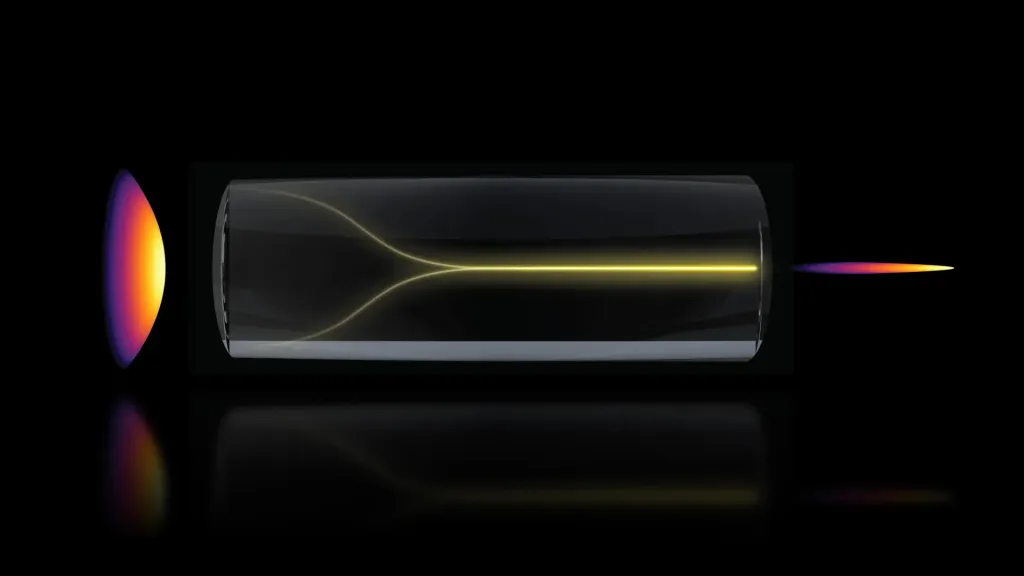
MIT scientists discovered that chaotic laser light can self-organize into a focused 'pencil beam' under specific conditions, enabling faster and more detailed imaging of living tissue. This new method allows 3D imaging of the blood-brain barrier at speeds 25 times faster than current techniques while maintaining image quality. It also permits real-time observation of drug uptake in brain cells, potentially accelerating research on neurological diseases.
- ▪Chaotic laser light can spontaneously form a highly focused 'pencil beam' when entering a multimode fiber at a zero-degree angle and at high power levels.
- ▪The self-organized beam enables 3D imaging of the blood-brain barrier 25 times faster than the current gold-standard technique.
- ▪Researchers can now observe in real time how individual brain cells absorb drugs, which may improve the development of treatments for diseases like Alzheimer's and ALS.
- ▪The discovery challenges the common belief that high-power lasers in multimode fibers always result in chaotic light scattering.
- ▪The effect relies on nonlinear interactions between light and the fiber material, which counteract the fiber's intrinsic disorder.
Science News files mainly under science. We currently carry 42 of its stories.
Story provenance
Source · retrieval · rights · ranking — open for full record
inspect →
Story provenance
Attribution is not the same as permission. This drawer separates discovery metadata, excerpts, WeSearch-generated summaries, reuse status, and whether the publisher receives the visit. Nothing here claims a legal grant the publisher has not made.
Record
| Original publisher | Science News |
| Canonical URL | https://www.sciencedaily.com/releases/2026/04/260428045542.htm |
| Publication time | Tue, 28 Apr 2026 09:10:39 EDT |
| Retrieval time | 2026-04-28T13:14:31.934Z |
| Last seen | 2026-04-28T13:14:31.934Z |
| Headline source | Publisher (no WeSearch rewrite) |
| Excerpt source | publisher body |
| Excerpt method | First ~120 words (~800 chars) of extracted publisher body, fair-use limited. |
| Summary | WeSearch · cerebras-chat (WeSearch summarizer) |
| Summary source text | contentText |
| Citation coverage | Summary is a WeSearch-generated derivative; primary citation is the original publisher URL. |
| Cluster | zt6jvSy9KR42 |
| Cluster logic | Grouped by semantic title/content similarity across sources within a rolling window. Same-publisher template collisions are excluded from coverage comparison. |
| Ranking reason | Story pages are not engagement-ranked. Hub feeds use recency, with optional source-diversified chronological ordering (cap consecutive stories per source). No personalized ranking. |
| Publisher visit | Yes — open original |
| Substitutes article? | No — link-out required for full text |
Rights status (four layers)
WeSearch handling by dimension
| Indexing | May the item be indexed (stored, ranked, made findable)? | Allowed |
| Snippet | May a short excerpt of the publisher's text be shown? | Allowed |
| AI summary | May WeSearch generate its own short summary of the article? | Limited |
| Retrieval / RAG | May the content be exposed for third-party retrieval-augmented generation? | Not asserted |
| Model training | May the content be used to train AI models? | Not asserted |
| Commercial reuse | May the content be reused commercially? | Not permitted |
Basis: Derived from the published RSS/Atom feed. Contact: [email protected]. Reviewed: 2026-07-24.
Opening excerpt (first ~120 words) tap to expand
Science News from research organizations MIT scientists turn chaotic laser light into powerful brain imaging tool Chaotic laser light just learned a new trick—turning itself into a precision beam that could fast-track brain disease research. Date: April 28, 2026 Source: Massachusetts Institute of Technology Summary: Scientists at MIT discovered that chaotic laser light can spontaneously form a highly focused beam instead of scattering—if the conditions are just right. This “pencil beam” enabled them to image the blood-brain barrier in 3D at speeds 25 times faster than existing techniques. The method also lets researchers watch how drugs move into brain cells in real time. It could dramatically accelerate the development of treatments for neurological diseases.
…
Excerpt limited to ~120 words for fair-use compliance. The full article is at Science News.
Discussion
0 commentsMore from Science News