What Congress Could Do to Stop the War
The United States has been engaged in a war of choice against Iran for nearly two months, with ongoing negotiations failing to end the conflict. Despite the war's economic and geopolitical consequences, Republican-controlled Congress has largely supported President Donald Trump's military actions. Congress retains constitutional power to constrain the president through funding control, as demonstrated historically during the Vietnam War.
- ▪The U.S. has been conducting a bombing campaign against Iran that has destabilized the global economy and strained alliances.
- ▪Senate Republicans blocked a Democratic proposal to limit the president’s war powers, even during a cease-fire.
- ▪Congress has the constitutional authority to restrict military funding, a power used in 1973 to prevent renewed operations in Southeast Asia after the Vietnam War.
- ▪Republican lawmakers continue to support the war, viewing it as politically advantageous despite declining approval ratings and internal party concerns.
- ▪The Iran war has not eliminated the regime’s nuclear capabilities, which remain intact within the country.
Foreign Policy files mainly under world. We currently carry 82 of its stories.
Story provenance
Source · retrieval · rights · ranking — open for full record
inspect →
Story provenance
Attribution is not the same as permission. This drawer separates discovery metadata, excerpts, WeSearch-generated summaries, reuse status, and whether the publisher receives the visit. Nothing here claims a legal grant the publisher has not made.
Record
| Original publisher | Foreign Policy |
| Canonical URL | https://foreignpolicy.com/2026/04/28/congress-stop-iran-war-budget/ |
| Publication time | Tue, 28 Apr 2026 04:01:45 +0000 |
| Retrieval time | 2026-04-28T04:35:00.049Z |
| Last seen | 2026-04-28T04:35:00.049Z |
| Headline source | Publisher (no WeSearch rewrite) |
| Excerpt source | publisher body |
| Excerpt method | First ~120 words (~800 chars) of extracted publisher body, fair-use limited. |
| Summary | WeSearch · cerebras-chat (WeSearch summarizer) |
| Summary source text | contentText |
| Citation coverage | Summary is a WeSearch-generated derivative; primary citation is the original publisher URL. |
| Cluster | I48RsQQHPx6s |
| Cluster logic | Grouped by semantic title/content similarity across sources within a rolling window. Same-publisher template collisions are excluded from coverage comparison. |
| Ranking reason | Story pages are not engagement-ranked. Hub feeds use recency, with optional source-diversified chronological ordering (cap consecutive stories per source). No personalized ranking. |
| Publisher visit | Yes — open original |
| Substitutes article? | No — link-out required for full text |
Rights status (four layers)
WeSearch handling by dimension
| Indexing | May the item be indexed (stored, ranked, made findable)? | Allowed |
| Snippet | May a short excerpt of the publisher's text be shown? | Allowed |
| AI summary | May WeSearch generate its own short summary of the article? | Limited |
| Retrieval / RAG | May the content be exposed for third-party retrieval-augmented generation? | Not asserted |
| Model training | May the content be used to train AI models? | Not asserted |
| Commercial reuse | May the content be reused commercially? | Not permitted |
Basis: Derived from the published RSS/Atom feed. Contact: [email protected]. Reviewed: 2026-07-24.
Opening excerpt (first ~120 words) tap to expand
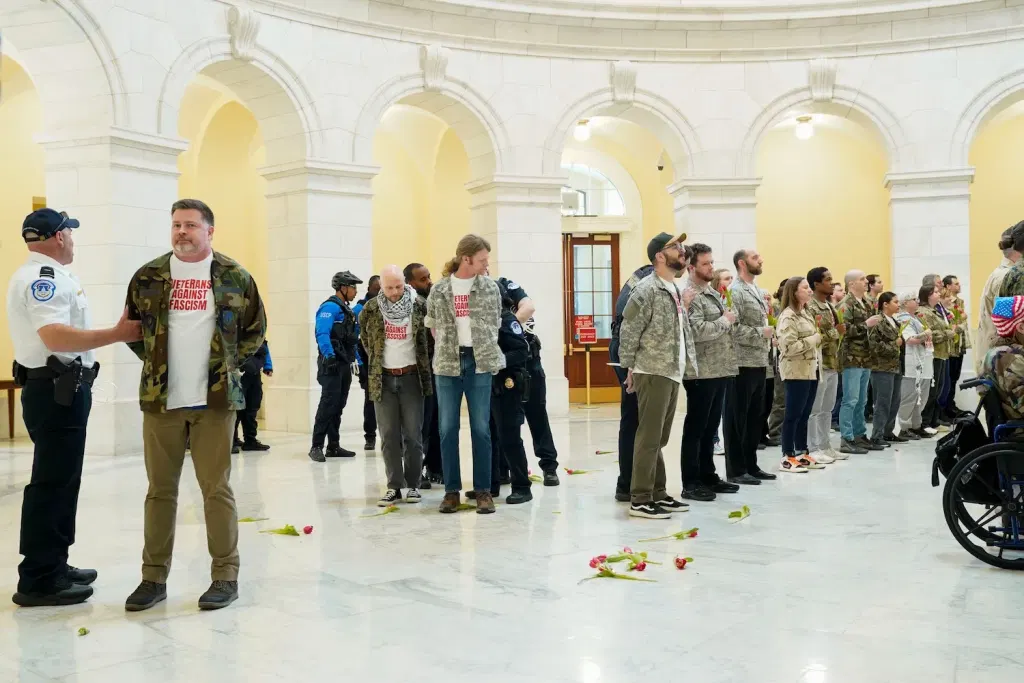
Analysis What Congress Could Do to Stop the War Republicans are declining to use their power of the purse. A pencil drawing of a man smiling and wearing glasses Julian E. Zelizer By Julian E. Zelizer, a columnist at Foreign Policy and a professor of history and public affairs at Princeton University. Sign up for Julian’s newsletter, The Long View, here. Veterans, military family members, and supporters are detained by U.S. Capitol Police officers during an demonstration in the Cannon House Office Building on Capitol Hill, Washington, on April 20. Veterans, military family members, and supporters are detained by U.S. Capitol Police officers during an demonstration in the Cannon House Office Building on Capitol Hill, Washington, on April 20.
…
Excerpt limited to ~120 words for fair-use compliance. The full article is at Foreign Policy.
Discussion
0 commentsMore from Foreign Policy